Friday, March 30, 2012

Children's Books


Reading Rudyard Kipling’s The Jungle Book got me to thinking about the time I sat with a married couple at a Denny’s on the outskirts of Baylor University’s campus late one night after a drinking binge, eating pancakes. At the table next to ours sat four Baylor students. One of the girls, maybe 19 or 20 years old, held open the children’s book Where the Wild Things Are. She read it aloud to her boyfriend while he squirmed in his booth, his eyes darting from his lap to the diners sitting nearby. He was clearly uncomfortable.

I’d read the book when I was a child, and the story, coupled with the haunting illustrations, had left an impression on me. My friend Kent, however, began speaking the lines from the book right along with her. I was impressed. So was the girl. She stopped reading and turned. “You have it memorized!”

Kent nearly blushed. “One of my favorites.”

Kent’s wife squeezed his arm, smiled back, and whispered to him, “That’s not all he knows by heart.”

Before you roll your eyes and wonder why adults would read children’s books, there’s something you should know. Where the Wild Things Are notwithstanding, children’s books are very often more sophisticated than your average adult novel. Don’t believe me? Forget the film versions and Disney’s rendition and read Lewis Carroll’s Alice In Wonderland. It’s highly philosophical. How about C.S. Lewis’ children’s series The Chronicles of Narnia? Lewis was an English professor and a scholar. That series is full of truths many adults still don’t grasp, not to mention the allegory and sophisticated themes that you generally won’t find in paperback novels. True, there are plenty of children’s books that teach nothing, stories that never consider or explore anything an eleven year old hasn’t already been taught. But this, incidentally, describes many novels for grown-ups, too.

Yes, children’s books often involve things like talking animals, but so does George Orwell’s Animal Farm, and that’s clearly not for children. Absurd themes, elementary grammar, simple concepts, and childish characterizations aren’t confined to the grade school or young adult sections of your local bookstore. In short, the distinction between children’s tales and novels for grown-ups is often tenuous at best.

I don’t think I ever saw Disney’s rendition of The Jungle Book, but the book itself is excellent. Each story is self-contained, though a few involve the same characters. The first five of the seven stories are brilliant. And while the stories are all in prose, at least one poem precedes each tale. One of my favorites began “Tiger-Tiger”, which is in Q & A form:

What of the hunter, hunter bold?
Brother, the watch was long and cold
What of the quarry ye went to kill?
Brother, he crops in the jungle still
Where is the power that made your pride?
Brother, it ebbs from my flank and side
Where is the haste that ye hurry by?
Brother, I go to my lair to die

The poem “Seal Lullaby” precedes the story “The White Seal”:

Oh! Hush ye, my baby, the night is behind us,
          And black are the waters that sparkled so green.
The moon, o’er the combers, looks downwards to find us
          At rest in the hollows that rustle between.
Where billow meets billow, then soft be thy pillow,
          Oh, weary wee flipperling curl at thy ease!
The storm shall not wake thee, nor shark overtake thee,
          Asleep in the arms of the slow-swinging seas!

In the Afterward, Jane Yolen quotes C.S. Lewis: “I am almost inclined to set it up as a canon that a children’s story that is only enjoyed by children is a bad children’s story.” Wikipedia’s page on Children’s Literature makes it clear just how unclear the distinction really is. Did you know some children’s books were written not just for children but actually by children? Simply put, categories are misleading.

I prefer to label books based on the writer’s craft, his or her command of the language, whether the characters are engaging, how moving or insightful the telling is. Of course if books were categorized according to those standards, we’d find out which were truly juvenile. After all, if it’s true you can’t judge a book by its cover, why should we judge a book by the category stamped on its spine?


Sunday, March 25, 2012

Muffin Man, Brad Whittington

“What’s it about?” is the first thing anyone asks when you recommend a novel or a film. What it’s about determines whether we’ll take the initial plunge. But that’s rarely the only reason we turn the next page. There are plenty of factors to recommend Muffin Man, and like all good stories (or at least stories well told) the plot is only one of the many elements in its favor. I’m not the type to reveal spoilers, so I won't summarize what happens. Besides, I'm more concerned with style and the use of metaphor or a well placed simile. These are the key ingredients to a delicious read.  

John … into the full heat of a Texas August afternoon ... felt like he was rolled in an electric blanket in a convection oven inside a sealed boxcar on the train to Hell.  

Lovejoy was barely out of the academy, so new the shine hadn’t worn off yet.

…nailing down a complete list of the protestors was about as likely as stacking marbles on a basketball.

Her drawl was so dense it could seine for minnows.

It was hot, but a different kind of hot. Softer, more like a blanket or an oven full of chocolate chip cookies than the fist-in-your-face, steel-melting blast furnace of the parking lot.

The grass was calf high and thirsty. It rustled like old newspapers against his pants leg … But the weeds were doing just fine, which was the way of it. The good guys had to push uphill both ways just to stay even.

He was at his worst when he meant well…

She’d moved on months before she’d moved out.

[He]…shook his head like a bull trying to rid itself of a horsefly.

She wore a silky, shimmery cranberry blouse that was tight enough to display her charms but loose enough to avoid bragging …

Beyond plot and style, novels are about evoking, getting the reader emotionally invested. Only when the writer breathes life into the characters do we truly care about what happens to them. That’s really why we turn the page, because we’ve been convinced that what happens next matters. In short, whatever your demands for a novel, Mr. Whittington satisfies them all. Highly recommended.

Sunday, March 11, 2012

Sex in Novels

I was once seduced by a Harlequin romance novel at a book store. Don’t worry; I’m not pressing charges. This was back when I judged books exclusively by their covers. This one sported a shirtless, chiseled bronze god embracing a tender belle whose hair tumbled forth like an avalanche of blonde silk. It called to me, you might say. Out of curiosity more than anything else, I wondered why these sorts of books appealed to widows and lonely housewives. But when I got it home and cracked it open, it was neither erotic nor romantic. Not for me anyway. I’ve since learned my lesson.

The Story of O, by Pauline Réage, was both beautifully well written and horrifying. I don’t recommend it. It was banned for a number of years when first published back in 1954. Suffice to say bondage was the tamest of our protagonist, O’s, many experiences.

Then Charles Bukowski’s The Most Beautiful Woman in Town and other stories had a particularly scatological tale involving two brutes who defile a female corpse. That’s all I’ll say, beyond, once again, the disclaimer: not recommended.

Oh, and an anthology of short stories composed by lesbians called Women on Women 2. Unfortunately, the sex was little more than laundry lists of naughty parts, naming genitalia and dropping anatomical terms you’re likely to hear in a biology class. But it wasn’t erotic either. In fact, it was downright dull. A tip for all you aspiring erotic slash romance writers: don’t allow your love scenes to read like an exercise regimen or a step by step for applying CPR. It doesn’t produce the desired results.  

Some examples. And no, sadly, these are real.

Her blood roared through her veins as if it were jet-propelled. She arched off the ground, crying out his name. And her whole body convulsed into a chain of spasms, within and without.

‘Jet-propelled’ should be reserved exclusively for water sports vehicles and industrial sized farm equipment. It’s hardly a romantic term, and ‘crying out his name’ is an overwrought cliché. ‘Within and without’ is just excessive. Might as well say ‘both physically and spiritually’, although in fairness the writer might’ve been referring to the woman’s anterior vaginal wall. Romantic, right? I didn’t think so either. Besides, we get the idea long before the distinction is offered.

There wasn’t an inch of her that he didn’t taste – from the base of her throat to the curve of her waist to the backs of her knees to her candyapple-red toenails.

What about her clavicles, her calves, her clitoris? There’s a certain degree of understanding by the reader when a love scene unfolds. Being told the thigh bone is connected to the knee bone is something we can do without.

He stared deeply into her eyes, searching for signs of mendacity, but saw only leaping arcs of desire. He impressed a hungry, twisting kiss on her receptive mouth. His sex became even fuller within her caressing grasp. He nudged her knees apart and settled himself heavily within the cradle of her thighs.

That is so bad it’s actually funny, like a B movie that takes itself way too seriously, causing the audience to crack up and shake its collective head in pity.

A friend once wrote that unless the sex is pivotal to the plot, it really serves no greater function than, say, a character releasing his waste in the toilet. That’s a healthy sentiment, and I agree for the most part. But there are a few exceptions. Perhaps it’s the voyeur in me, but I don’t really mind reading sex scenes if – and this is a big if – if they’re original and tasteful. Of course adjectives like ‘original’ and ‘tasteful’ demand qualifiers, so I’ll try with examples.

Stained Glass, William F. Buckley Jr’s spy novel, has three sex scenes. None of them explore the minutia of the physical act itself. So at no time do you feel you’re reading the details of an inquest or a sex abuse scandal. In fact, if you had stumbled on this scene midway through, you might not think it’s a sex scene at all. Keep in mind this takes place near St. Anselm’s in Germany circa 1950:

… she looked him in the face, squeezing him past pain to pleasure. He breathed with difficulty and suddenly she was Florence Nightingale dressing his wounds, bringing him back to life from battle, triumphant in her powers, and now they were airborne, riding high over St. Anselm’s and the forests of Westphalia, higher, higher, so high they could see all of Germany and now Poland, England, Russia, and soon the Atlantic and the whole world, round and round they sped, the pleasure trip on the nonstop intergalactic flight until the moment came for the dive down to that little twinkling village by the sleepy old castle of St. Anselm’s, just making it in their spaceship, just in time to their bed, in a delirium of pleasure.

Not exactly poetry, mind you, but not a grocery list run down of lips and limbs and fleshy contortions either. This next scene is perhaps one of the more strange allusions to sex:

And, moments later, his mind turned on the legend of the little boy in Holland sticking his finger in the dike to hold back the floodwaters. He wasn’t using his finger, he reflected, but however temporarily, the substitute was working: holding back the floodwaters in his mind. She was Erika, beautiful, warm Erika born to love and be loved, not to attend to the devil’s housekeeping. He? He was what? He was simply the little Dutch boy, holding back the floodwaters. 

The less literal the telling, the more poetic or metaphorical or laced with simile the narrative is, the more I tend to like it. My favorite dead author does it best. In his novel Look at the Harlequins, Vladimir Nabokov makes the vulgar beautiful in ways only the poet can:

The delights of puberty granted me temporary relief. I was spared the morose phase of self-initiation. Blest be my first sweet love, a child in an orchard, games of exploration – and her outspread five fingers dripping with pearls of surprise.


Tuesday, January 31, 2012

Book Mark Rants

I don't want to seem like a snob. I probably am. I just don't want to appear that way. I have nothing against entertainment in general. Who does? But I'm also a lover of the arts. And by arts I mean music and literature, and by literature I really mean good books in general. For those of you not familiar with my take on art, I differentiate it from entertainment. Example, Lady Gaga is a performer. She wears costumes; she dances; she tries to sing. But she's an entertainer. Or as I like to think of her: a hot dog: more preservatives than meat. The irony may be that she’s worn it. Her image is everything – attitude, choreography, flipping off media at a ball game, etc. She’s imaginative and bold, and something can be said for those who succeed in that field, though not much. But I don't consider her an artist per se. I mean, while her sub-field is music, she's not a musician. Which is just as well since most consumers aren’t concerned with music in general anyway. This might help explain why she and others like her are so successful. They realise that the paying public doesn't care for galleries and symphony enmass. Apart from romantic comedies and the occasional indie film, we tend to pay to see movies whose bzillion dollar budgets go to special effects, not story. Successful film makers often use sequels to draw in audiences, not necessarily actors' performances or a solid script. But this isn’t a condemnation of the general public and their apathy with the arts. I certainly don’t want to give the impression that I find the unwashed masses beyond redemption. 

Maybe as a society we’re oversaturated with art to the point of inoculation. Maybe Shakespeare was right, that there’s nothing new under the sun, or that nothing new gets noticed anymore unless it's designed to shock us. If so, then maybe those artists’ motivations are wrong. This might explain the end result, though, at least in some cases, such as Transformers, the Piss Christ, or Lady Gaga.

The writing medium is no exception. Some writers may be concerned with getting published or being famous. Others are driven by a mission, a ministry, or some other agenda. These writers aren’t necessarily concerned with good writing, though. Instead they tend to be motivated by a creed entirely indifferent to art. Brothers Todd & Jedd Hafer are prime examples of this. Their novel Bad Idea is paperbound with good intention. From my understanding the brothers are involved in outreach programs -- getting kids off the streets and so on. Noble and worthy causes, but don’t confuse this with art. Hell, for the sake of argument, I’ll allow that this is more ennobling than art itself. Still, attention to a good story and quality writing can’t hurt anyone either, and this is a novel after all, not a self-help book for parenting. My Tweet earlier this month was inspired by my impressions of this book, and it warrants a repeat: “Faith should inform one’s art, not throw a yolk on it, crack a whip, and say, ‘mush!’ Let your convictions set tone, not play Puppet Master.”

While art sometimes serves as a springboard for social commentary and the like -- a vehicle for improving one's mind or providing insight -- its purpose should be to evoke. It should never be used to bang the audience over the head with some view the author holds dear. Sure, much of this is subjective. In fact, it could be argued that there's an audience for everything. Art be damned. That sort of thing. After all, if you find Adele dull and Madonna brilliant, it won’t matter to you whether one can sing and the other can’t. If you know all P Daddy’s Hip Hop by heart and have never heard a single work by Chopin, who am I to judge? So what if some awful writer finds fame and fortune while great works remain unread by most. Welcome to the real world, right? I get it. But I’m still allowed to hoot and holler and demand justice – at least the poetic kind.

Blue Hearts by Jim Lehrer is a different novel altogether. This story is all about getting our characters from point A to point B. Economy of words is the overriding theme, and I have no problem with this. However, the story is pretty dry and would’ve worked well as a TV episode. (That’s not a compliment.) The inner conflict or motivations of the characters are rarely mentioned and never in a way that allows the reader to care.

Still, I shouldn't cast aspersions on Lehrer or his story. Writing is hard work, and Lehrer isn't bad. He just doesn’t evoke. It doesn’t seem to concern him. Which is fine; this is espionage after all. Not a love story. However, contrast this with a different book of the same genre, Stained Glass by William F. Buckley Jr., and you see that espionage and drama and romance and personality can and does blend well together. (More on Stained Glass next month.) 

Then there's the third and last novel in Robertson Davies’ The Salterton Trilogy, A Mixture of Frailties. While this isn't his best story (and my least favorite of the trilogy), it’s still very good and better than everything else I read this month. Davies is a true artist, and what he says about critics, music and relationships is beyond insightful; it’s damn well inspired. His characters express our own joys and fears, reminding us of both what we tend to forget and what we’ve always known. You really can’t ask for more than that. His prose is smooth and don’t intrude on the story, encapsulating what good writing is all about. A good writer and friend once told me that you know it's good writing when you don't even realise you're reading. Davies achieves this. I just can’t decide whether I love him or envy him more.

Friday, January 6, 2012

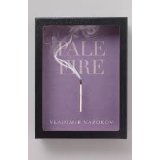
"Pale Fire" by Vladimir Nabokov

Based solely on the Table of Contents (Forward, Poem, Commentary) you might assume you're in for a dry academic study of a poet’s work. This is the book’s veneer. Once peeled away, an exhilarating story unfolds. Pale Fire is written, first person, by one Charles Kinbote, a native of Zembla, now living in New Wye, Appalachia, and a recently hired professor at Wordsmith College. Before this book is published, Kinbote rents a house from one Judge Goldsworth, who years ago had a madman named Jack Grey committed to an insane asylum. The judge is away on sabbatical when Kinbote moves in. 

Next door lives our celebrated poet, John Shade. He writes a 999-line poem he entitles Pale Fire – stirring verse full of poignant imagery, double entendres, brilliant puns and word games. (As a rule, I deplore poetry; but this is fantastic stuff.) Shade dies; the manuscript falls (you’ll learn how) to Kinbote. He writes the accompanying Forward and Commentary and finds a publisher. 

This is that book.

Initially you might think Kinbote will be the ideal critic for Shade’s poem; in the course of their budding friendship, the two minds (Kinbote alleges) became twin souls.

But our smug émigré spends more time telling us about his Zemblan homeland than about Shade’s poem. Kinbote claims that he often entertained Shade with stories about Zembla and about the revolution that led to its king’s imprisonment. It was after this that Shade began work on his epic poem, Pale Fire. For this reason, Kinbote assumes Shade’s poem would focus on Zembla. Instead, Shade wrote about life and family. Indeed, you begin to suspect Shade never intended to have the poem published! Kinbote fails to see this; he’s too preoccupied with inventing clever connections between his own vain and self indulgent telling and Shade’s verse.

The similarities are strained at best. Or are they? At times it seems Shade may have indeed buried Zemblan themes deep in his writing. Kinbote is so persuasive. Zembla’s king escapes from the bloody revolutionists, ends up in France, where, Kinbote claims one Jakob Gradus, a hired gun, is directed to find and assassinate him. 

Kinbote continues to use Shade’s poem as a springboard for an engrossing story of Zembla and its monarch, all the while, says Kinbote, corresponding to verse from the poem, if not in content, at least chronologically. For as Shade was filling out index card number 243, which would become lines 740 to 748 in canto four, the brute was boarding a plane bound from Paris to a quiet little countryside in New Wye.

The day Shade completes his poem he accompanies his neighbor Kinbote to the fellow don’s rented house, manuscript in hand, perhaps planning a toast. On Kinbote’s porch, so Kinbote says, both poet and admirer are met by Gradus, who draws his revolver, fires at our fugitive king Kinbote, but hits the genius Shade instead. This is actually Jack Grey escaped from the asylum, seeking his revenge on Judge Goldsworth. But Kinbote doesn't seem to make the connection, though he does allow that Shade resembles the judge.

Kinbote reports that he later visited the assassin in prison and that the man pretended he’d never heard of King Charles II of Zembla. Nor would he acknowledge he’d been sent on a mission to assassinate him. A thug, but a loyal thug, Kinbote decides.

But is Kinbote really a fugitive king? Does Zembla even exist? 

The book is full of literary gems and jests like these. You’ll enjoy uncovering what appears to be the façade only to discover a dream. Innuendo rushes along just beneath the lines, and once you’ve finished reading the witty Index, you’ll want to go back and do it all over again. Certainly one of the best books I’ve read. Subtle. Amusing. Brilliant.  

"Tempest-Tost" by Robertson Davies

First book in the Salterton Trilogy. I’d read book two, Leaven of Malice, first, back in November (see blog post). That was a paperback stand alone. Then nearly two weeks ago I found the whole trilogy in a thick paperbound book hiding in a bag against my bedroom wall. Didn’t even know I had it. I swear; I really need to clean my room. This stack of thirty-seven pizza boxes is about to tip over too.

Reading the books out of sequence didn’t hurt anything; the stories are self contained.

Great books are like a seduction, an intimate relationship between reader and writer. When the writer’s command of the language is sure, the reader will moisten the fingers and caress the story as it unfolds, soon “mmm-ing” and “ah-ing” as another pleasure is laid bare. Eventually the writer has the reader in the throes of a passion and an ecstasy until ultimately the reader is panting, lying naked, and in a fevered delirium!

Or is that just me?

Book three, A Mixture of Frailties, closes out the trilogy, so I’ll be reading that next. And maybe smoking a cigarette.  

How Learning a New Language Improves One’s Life, and other Trivia

Some things are inexplicable. For example, my desire to teach myself a second language at age fifty-two. And what, pray tell, was that secon...