Wednesday, September 12, 2018

Black Beauty, Anna Sewell (1877)


I love horses, but my experience with the animal is sorely lacking. As a teen, I once sat on a grey mare belonging to a friend of the family and was led in a circle or two within a small corral. My feet barely reached the stirrups. I remember the sway of the saddle against my hams and thighs and unaccountably contrasting it with my bike seat and the backseat of my parent’s Monte Carlo. Later as an adult in the NAVY, some sailor friends of mine and I drove down to Baha, Mexico and one morning after a punishing night of binge drinking, one friend and I rented a pair of temperamental horses, his a chestnut stallion, mine a dappled mare. We cantered along an overcast beach until things became dangerous when my friend’s mount tried to mount my own.  

Having spent most of my life in an urban environment, opportunity to ride rarely presented itself. So I know next to nothing firsthand about the species. Most of what I know about their habits and habitat, diet and history, I learned from books. Which is unfortunate, considering how beautiful and majestic horses are. Many of them are quite graceful and statuesque, and though I’ve never had the privilege to ride one at a gallop, I imagine it would be exhilarating.

Since my current writing project, book two of a trilogy, is set in a period mirroring our own Middle-ages, knowledge of all things horse would benefit my work. Not to slight knowledge accrued from books, far from it, but I suspect personal experience would go a long way toward projecting authority and authenticity in my narrative.

Needless to say I’ve settled for the next best thing. In addition to the research I’m doing online, I recently downloaded this Public Domain ebook from Amazon for free, partly because it’s considered a classic, partly because I thought I’d learn a few more useful things about horses.

My impressions of the book are mixed. While I feel the contents herein taught me a good deal of useful stuff that’ll lend itself to my manuscript, I haven’t much else to say positively about the novel. The writing isn’t bad. However, there’s no real story here. Certainly no plot.

Our eponymous protagonist Black Beauty narrates first person, or first horse. So the dialogue is limited to what people say to and near the horse and what Black Beauty and the other equine community communicates to one another while enjoying a respite.

Since the protagonist has no goal or ambition apart from making his masters happy and avoiding needless pain at the hands of the indifferent, the ignorant, the drunkard, or the malevolent, events simply occur, and Black Beauty offers his commentary and impressions accordingly. But the horse has no underlying need or desire or objective. As a result, we readers have neither anyone nor anything to root for as our protagonist is subjected to all varieties of tasks and abuse.

Apart from championing the virtues of hard work and compassion for the lesser animals, the supporting cast of characters has little to offer in the way of insight into human nature. I suppose this is tolerable when reading a high-octane thriller, but in a book casually chronicling the life of a horse, characters can’t afford to be bland. Nevertheless, the cast shuffles in and out of Black Beauty’s life with little mention beyond its buying or selling the animal and treating it well or poorly.

Notwithstanding their puritanism, these people reveal next to nothing about themselves, though, in fairness, they do reveal a good deal about the period. Black Beauty reveals little more, noting only whether those he is introduced to appear kind or cruel, young or old. And unless someone drank or neglected his duties in the service of the horse, no conflict appears. Most of the dialogue is limited to Christian adages and abstention to such a degree that it grew somewhat annoying. (The author’s aversion to drink is evident throughout, and her depiction of anyone indulging is always negative.)

The only thing Sewell was liberal about was in her point to chastise (via her protagonist Black Beauty) those who ill-used horses or engaged in unhealthy practices, as well as what sort of punishment Black Beauty, and by extension the author, felt commiserate to their crimes.

As to learning anything useful from this book, I did indeed. The author demonstrated an impressive knowledge of all things horse. I suspect she wrote from personal experience. I took notes about what not to do or feed a horse after a hard run, how to properly maintain a stable, etc. We must remember the horse was the main mode of transportation throughout much of human history, certainly during the nineteenth century in merry ole England, when people utilized coaches and cabs and gigs as incessantly as New Yorkers utilize cabs today. Not only did Sewell appear to thoroughly understand the habits of riding and its variegated rider or cab driver – whether sympathetic or indifferent to his horse – she knew a great deal about riding gear, its purpose, and its (often deleterious) effects on the animal.

Though she barely alludes to the subject, it would appear human population had begun to render horse and buggy overtly strained. Without the eventual invention (and intervention), of the automobile during the late nineteenth and early twentieth centuries – since prior to this advent many cab drivers were renting out their services seven days a week, sometimes sixteen hours a day (overtaxing their horses) – our inhumane treatment of horses might’ve produced a far less palatable relationship with our equine friends. In fact, given Sewell’s focus on the individual suffering of horses in the story, I’m surprised she didn’t devote attention to this widespread problem apart from two brief conversations that only indirectly hint at the issue.

Sewell exercises strong opinions about the value and efficacy of the riding tools in fashion at the time. From check-reins, blinkers (or blinders), ring snaffles, and other particulars – whether it be a saddled horse, horses attached to a coach, a brougham, a phaeton, or any number of conditions a horse is subjected to in the service of its master, such as the effects various terrain have on hoofs and shoes and a horse's legs, how a rider utilizes the reins, the whip, etc. She is harsh in her critique of the cruel or derelict owner or rider, frustrated by the subsequent sickness a horse can incur due to ignorance and indifference, and so on.

I won’t deny the narrative was moving in spots. While I’m typically not sentimental, some of what these innocent creatures endure can be heart-wrenching. Viewing this practice from a horse’s perspective can’t be otherwise. For a host of reasons, some understandable, others not, many horses were overworked until either sickness and decease set in and they died prematurely. Some would struggle until their knees gave out, their spirits sagged, their eyes went dull, and they were either set out to pasture in the hopes that they would improve and return to work, or they’d die and be sold for glue or some such.

I’m glad I read the book, but with regards to the story or lack thereof, the book suffers from an excess of moralizing and treads perilously close to a sermon or glorified religious tract. Overall not awful but not great. Three out of five stars. Rated G

Thursday, August 16, 2018

12 Rules for Life, An Antidote to Chaos, Jordan B. Peterson (2018)

If you follow my blog, you’ll know that my book reviews are subverted by my ego. By that I mean I tend to inject my own impressions at the cost of the book. Rarely do I break down the plot of a novel under review or explore characters or theme. That’s because, for those interested, one can find an array of book reviews about any given book on Amazon alone. What matters to me, and hopefully to my readers, is not what a book means to someone else. What matters most is whether a book impresses or challenges or facilitates a change in me. Both fiction and non-fiction do this sometimes. The only time I care what someone else thinks about a given book is when a friend of mine has either read that same book or has a book recommendation of his own.

Books are a great vehicle for growth because they lend themselves to both self-discovery and self-improvement. At least potentially. This might explain why I became an autodidact decades ago – to learn all I could learn about what interested me most. Be it literature in general, writing, philosophy, psychology, history – interest in this stuff leads me back to my love for reading. I strive to learn new things, not only about myself but about the world around me.

I don’t mean merely increasing my vocabulary or boasting rights about classics I’ve read or becoming better at trivia. What I’m referring to is far more substantive. I won’t go into the many benefits to reading. I’ve discussed that in previous posts. Besides, fellow avid readers know. The less fortunate are left to guess.

As a result (a disquieting result), I don’t have many friends. I just don’t invest the time required to establish and maintain friendships. Why hang out with a friend who wants to watch television or talk about her dog or go play darts at a bar if I’m not into darts or when I can stay at home instead and read a book while listening to my favorite music or work on a new writing project?

Does this make me a snob? Probably. Does this make me a misanthrope? A hermit? Antisocial? Perhaps in a sense. Am I proud of this? No. These labels are mere derivatives of an isolated lifestyle, not titles to which I aspire. Still, I admit the result is the same.

Which is why, after years of this subdued regimen, I decided to change course somewhat. I wouldn’t abandon my joy of reading or the satisfaction I derived from writing. But I’d seek to strike a balance. 

Following my blog you’ll know this began a couple years ago when I decided to pursue a spiritual path. Something that would better my heart, my soul. I explored faith. Catholicism to be exact. I began reading the Bible again. I added the Catechism of the Catholic Church to my reading regimen. I began praying the rosary. I did this for a host of reasons, one being because I thought it was the right thing to do. I wasn’t expecting the significant changes in my life this practice would produce. Miracles, you might say. I certainly call them that.

By doing this I discovered a great deal about myself. Shortly thereafter I talked with my doctor and received some startling news about my health. I decided to change my diet, lose weight, exercise.

So when I began reading Jordan Peterson’s book 12 Rules for Life, An Antidote to Chaos, the book couldn’t have come at a more opportune time. The groundwork for change had already been laid. Consequently, my personal journey took on an intensified strain. Without knowing it, I’d embarked on a quest far more challenging than I’d anticipated. A complete transformation was on its way.

Open to instruction, I found myself changing so rapidly that I experienced moments of bewilderment. I lost track of my identity. My old self morphed so quickly that, metaphorically speaking (and due to the exercise and diet too) my new reflection in the mirror struck me as a distant relative. Who was this thinner, happier, younger looking clone standing before me, smiling? 

Each chapter of Peterson’s book convicted me in unexpected ways. As a clinical psychologist, Peterson devotes much of his book to explaining how applying these rules leads to a good life and how failing to live these truths destroys the lives of those who would later come to him for help. While I can’t overstress the initial difficulty in applying these rules, I can’t overstress the life changing power or liberating qualities these maxims conferred either. 

For example, Rule Two is “Treat Yourself Like Someone You’re Responsible for Helping.” This forced me to address myself as if I needed help. Turns out I did. I’d already quit smoking and playing video games. Now I dumped additional vices and minimized others. I began practicing difficult virtues such as forgiveness, charity, temperance, patience. In short, I became a better version of myself, kinder, more giving, more sympathetic.

Rule Four is “Compare Yourself to Who You Were Yesterday, Not to Who Someone Else is Today.” This follows from Rule Two as a means by which to gauge your progress. I could track how much weight I’d lost, how much kinder I was to my fellow man, how much more productive I became both on and off work, etc. compared to the day or the week before. The rate at which I became a better me was chartable and consequently self-evident.

Rule Six is “Set Your Own House in Order Before You Criticize the World.” Put another way, look inward, not at what others have done to you, but at what you have done to others and, by extension, to yourself. A wise man once said, “The problems of this world begin here,” pointing to his heart. I’m reminded of the great wisdom of Socrates regarding the “unexamined life.” As a result, I engaged in some serious soul searching, an examination of my own life choices and behavior and, more importantly, how to stop doing (or at least minimize) what I knew to be wrong and do more of what I knew to be right. This prompted me to reach out to those I’d offended in the past. I apologized for my wrongdoing. A few forgave me and accepted me back into their fellowship. Others refused to respond. 

Rule Eight is “Tell the Truth, or, at Least, Don’t Lie.” This might’ve been the most difficult of all the rules to adopt, primarily because it forced me to abandon the person I presented to others and to instead offer up the real me for either their praise or their scorn. Much to my surprise, incorporating Rule Eight set me free. The yolk of guilt fell from my shoulders. My deception dissolved. I dropped the false façade I’d maintained for years and became my true self. Finally, I could look others I’d deceived in the past in the eye, others I’d withheld my thoughts and feelings from. While this made me more vulnerable, the rewards were more pronounced, more palpable. Perhaps because they stemmed from honesty and sincerity and were thus genuine.  

Ironically, this taught me two crucial things Peterson never mentioned. One, I have no right to decide what knowledge others are entitled to. Rather, I owe it those I know, especially to friends, to tell them exactly what I think and how I feel, not only about things in general but about them, too. It’s up to those friends to decide how to treat this knowledge. Whether they love or hate me as a result, embrace or reject me, is their call at that point, not mine. My only duty, my only obligation, is to be honest. Of course, true friendship includes other responsibilities, such as discernment and an effort to spare your friends’ feelings, but with regards to who you are, remember: truthfulness begets trust; honesty will set you, and potentially others, free.

Most of those I confessed my deep dark secrets to took it surprisingly well. In some cases, they were relieved. Others suspected the very things I’d thought I’d successfully concealed. My sense of guilt, remorse, and shame evaporated. The darkness cleared. The sun came out and shined brilliantly on this new path I tread.

Side bar: only one person took my confession about her poorly. She subsequently spun a tangled web of half-truths and falsehoods. Meanwhile, she shared my confession with at least one other, later denied it and accused the other of fabricating the whole thing, etc. It wasn’t pleasant. Gratefully, mutual others knew more about the situation, and about her, than I did. They verified that, yes, this is her nature, her character, her pattern. We’re no longer friends. But this is a good thing. Once I finally presented her with how I truly felt about her, I discovered something vital: exposing your true self to someone exposes them too. Pretense is often shared, and when one reveals one’s hand, the other’s tell or bluff is exposed.

As a result, my own feelings for this person dissolved. Sure. The initial pain smarted, but clarity is always best. I certainly don’t regret it. Presenting your true self and discovering whether that’s the sort of person the other person dislikes is a kind of emancipation. Both are spared the rigors of maintaining a deception, and that too is a good thing.

Which leads me to an earlier rule I skipped. Rule Three is “Make Friends with Those Who Want the Best for You.” Liars don’t want what’s best for you. Manipulators, gas-lighters, deceivers, are thinking first and foremost about themselves. Don’t waste your time with such people. Don’t resent them either. But detach yourself from their lives if possible. They will only use you otherwise. I should know; I used to be that person, too.

The second thing I learned by being honest, something Peterson never mentioned, something I lament somewhat, is that I can now often spot when others aren’t honest with me. The mannerisms – the shift in eye contact, the lilt or dive in pitch of voice – give them away. It’s like I’m wearing lie-detector lenses or magic ear pieces. I don’t begrudge them, of course. I used to do it too. But it keeps me on my toes. Call it discernment if you want, but I can’t help but grieve ever so slightly over this one byproduct. To be honest, and I can’t lie, sometimes I wonder whether I’d rather not know.

All in all, a great book. Read it. I think you’ll be glad you did. In fact, I’d say you owe it to yourself to become a better you. Applying these rules will set you well on your way toward that goal. Highly recommended. Five out of five stars. 

Wednesday, March 7, 2018

Why We’re Catholic, Our Reasons for Faith, Hope, and Love, by Trent Horn (2017)


Trent Horn regularly appears as a guest on Catholic Answers, a radio program I frequently enjoy, fielding questions from callers and impressing me with his intimate knowledge of both the Bible and the Catechism. Granted, they’re bush league questions, most of which could be answered using Google. Still. His voice is pleasant enough, his knowledge evidently vast, and, given his tone, it’s clear he has a big heart and wishes to help.

When, over the course of the radio program, the host advertised Mr. Horn’s book, Why We’re Catholic, I immediately ordered a copy, anticipating a more thorough examination of the faith than a radio format could provide. You see, while Mr. Horn’s radio responses were neither exhaustive nor sufficient, I’d assumed this had to do with external factors – the host’s intermittent announcements, quarterly fund drives, callers taking forever to ask their questions, and other interruptions. Plus, much of my time spent listening was complicated by additional tasks – dressing for work, driving to work, cooking dinner, etc. 

As anyone knows who follows my blog, I consider the printed word superior to radio, television, and film. Books tend to convey knowledge more successfully than any other medium. They potentially tell stories better, increase vocabulary, evoke thought and emotion, stimulate mental activity and imagination, encourage reflection, nurture patience, improve memory, and cultivate tastes and discernment. For these reasons, I considered it only fair to read what Mr. Horn had to say on the subject of Catholicism before rendering my judgment about what precisely the Church teaches. (A few points of contention have since appeared. Perhaps I’ll expound on those points in a future post.)  

I don’t want to disparage the author Mr. Horn, but my first issue with this book is with the title. If you were to pick up a book called Why I’m a Capitalist, would you expect the first few chapters to deal with why the author isn’t an anarchist? Notice anarchy is the absence of government whereas capitalism isn’t a form of government at all but rather an economic system. I combine unrelated ideas here only to illustrate my point. Why We’re Catholic lacks focus, and, as a result, the book short changes each and every element of faith it haphazardly tackles.

For example, in one short chapter Horn devotes only a few pages to epistemology, the study of how we know what we know, while serious philosophers have penned volumes to develop their theses. Another brief chapter reduces an argument as old and as eminent as Aristotle himself, the cosmological argument, to little more than bumper sticker slogans.

Neither of these chapters, by the way, makes an effort to differentiate Catholicism from any other faith. In fact, the first five chapters do nothing more than establish theism, and not well, I might add. Not until chapter six “Why We Believe in Jesus,” do we begin to distinguish one faith, viz Christianity, from another. However, Horn has very little to say about Catholicism specifically until chapter ten, “Why We Aren’t Bible-Only Christians,” and even then what he has to say isn’t always clear.

Indeed, at a mere 240 pages (including the Endnotes, which, incidentally, proved more authoritative and readable than the book itself), Why We’re Catholic reads more like a glorified tract than a book.

I’m not arguing for verbosity. I don’t require a book twice the length of this one before taking it seriously. Nor do I demand a scholarly tome by an academician writing exclusively to his peers. Not at all. I’ve enjoyed reading numerous notable, classic works of philosophy written specifically for laymen by some of the greatest minds ever to print their thoughts. But these great minds were also adept at communicating their ideas. They understood their audiences. In most cases, they also anticipated their intellectual opponents’ objections and provided answers for those dissenters.  

Mr. Horn is a poor imitator. The writing itself is first draft quality. Trains of thought venture nowhere. Visualize the surface features of a landscape rich in ascending peaks and deep valleys. This is the beauty, variety, and mystery of religious faith. Now watch as Mr. Horn zooms over this varied topography with his sonic jet style writing so that said landscape is but a blur. This is presumably done in an effort to prevent the average reader from becoming bored by the subject matter. Here’s a thought: don’t write for such people. Make a series of videos instead. An audiobook. A PowerPoint presentation at select churches and colleges.

Of course, I can’t speak for all readers, but ages ago, when I was an atheist, this approach only reaffirmed my disbelief. I submit that treating these serious subjects so casually does more harm than good. In short, dumbing down the material in an effort to appeal to a wider audience risks turning away the more sophisticated readers who seek meaningful answers.

I don’t want to be unkind (it may be too late), but Mr. Horn has access to nearly 2,000 years of Church history, with some of the greatest minds ever to put quill to parchment to draw from. He also has volumes of sophisticated philosophical input by the likes of everyone from Aquinas to Kreeft at his disposal, and yet this Cliff Notes summary, this Reader’s Digest version, is the work he submits to his publisher. Needless to say, I was embarrassed for both him and the faith. I have only myself to blame, though. I tend to forget walking encyclopedias aren’t necessarily logicians or even decent writers.

I understand the print medium lacks the benefit of a personal conversation, the back and forth interaction that allows two people of differing views to articulate precisely what they think and to clarify their position as necessary. For that reason, knowing how to address a reader’s unease and satisfy his concerns in print can be difficult.

But solutions abound. For one, Mr. Horn could’ve taken a page from the great essayists and approached the book entirely differently by quoting liberally from the great authors of the faith as it pertains to each chapter – “Why We Believe in Purgatory,” “Why We Honor Mary,” and so forth – rather than confining these quotes to the back of the book in the Endnotes. After all, Mr. Horn isn’t promoting an original idea here. Instead, he’s essentially summarizing Church doctrine in a nonchalant (I’d argue frivolous), superficial, way. Such a tone would significantly benefit from quoting the greats throughout.

Failing that, Mr. Horn could’ve simply asked a discerning friend or beta reader to read his manuscript before sending it off to a publisher. That reader could’ve spared everyone involved a good deal of hassle and embarrassment by asking Mr. Horn, “Are you kidding me with this!?”

Two out of five stars.

Sunday, February 11, 2018

Praying the Catholic Rosary Like You Mean It

If you’re familiar with my blog, you already know I was raised Protestant, lost my faith in my late teens, and became a self-professed atheist by my mid-twenties. You'd know that as an avid reader, I continued to explore the subject of God via the philosophical works of nearly everyone I could get my hands on. You’d likewise know that by my mid-thirties, I’d abandoned my atheism, concluding that faith in God, comparatively speaking, is far more rational than either no faith at all or faith to the contrary.

What you may not know is that, years later, after a series of extraordinary events (some tragic, a few miraculous), I decided to quit merely admiring the principles and virtues espoused by the great thinkers, leaders, saints, and writers of the ages and instead live such values as fully and as sincerely as I could. I continue to fall short, of course. I’m a sinner, after all, as this post will no doubt confirm.

I recently mentioned my discovery of Bishop Barron's wonderful Youtube videos about Christianity and the Catholic faith, and, eager to learn more about Catholicism in particular, I attended a Catholic service and later bought a few books on the subject. I have no Catholic friends, so in order to further prep for the R.C.I.A. (Rite of Christian Initiation of Adults), a class provided to those who wish to learn Catholic doctrine, I read from various Catholic sites and gleaned what I could from a local affiliate of a Catholic radio station. In addition to buying a couple copies of The Catechism, (more to follow about those tomes in the coming months), I also bought a couple of rosaries and two e-booklets which focus on the rosary prayers and the mysteries.

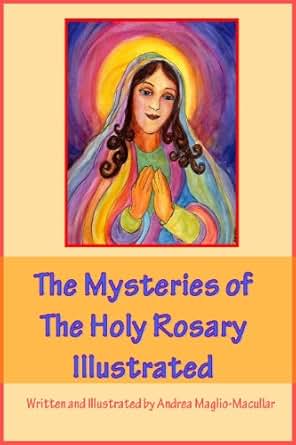
Now that we’re up to speed, let’s briefly review the awful booklet first. The Mysteries of the Holy Rosary Illustrated by Andrea Maglio-Macullar is an embarrassment to the faith. It’s composed by a watercolor painter slash writer slash rosary maker whose ignorance of basic English composition and painting wasn’t going to dissuade her from producing an illustrated booklet. I don’t mean to be a jerk here, but raised within a religious environment, I saw plenty of ingénues and dilettantes who wanted to share the Gospel despite their lack of talent. Think American Idol and those whose embarrassing auditions ended up on the reject reel.

Lest you brand me a curmudgeon, let me be clear. I salute those who wish to spread the good news. It requires courage, self-sacrifice. My only suggestion is that if you want to sing for the ministry, make sure you’re not tone deaf. Granted, your performance might break a listener’s heart and move him to convert, and that’s admittedly the essential purpose of the ministry. And yet, for what it’s worth, I’d respect you more if your ministry relates to your skill set and isn’t merely an excuse to force more mediocrity on the world, regardless your religious zeal.

Although Maglio-Macullar’s primary job was to reprint the traditional prayers found in a host of sources and a number of devotionals, she still managed to both omit and misspell words, as well as misplace punctuation, throughout. The illustrations, courtesy of the author, are of the caliber you’d find fashioned by children in day care centers in poorly lit … sorry. I’m trying to be a better person. Let’s move on to the good one.

Praying the Rosary Step-by-Step, by Rita Anna Bogna (with beautiful illustrations reproduced from the 1866 black and white woodcut engravings of Gustave Doré), is so much better in both quality and content that Maglio-Macullar’s e-booklet appears as a spoof in contrast. (Told you I was a sinner.) Anyway, this one is well worth the mere four bucks it cost. Well resourced, too, and thorough, with an Introduction about the history of the rosary, its associative prayers, as well as links to additional sources. Highly recommended. Five out of five stars.

It took me a week to complete this booklet because I went over it, you guessed it, step by step. As with the first booklet, each chapter is devoted to a set of five specific mysteries in keeping with Catholic tradition. By that I mean the booklet lays out the official prayers and practices – on which bead one recites this or that prayer, in which order – as well as the origins of a given prayer, and so on.

Exceptions aside, daily mysteries are fairly straight forward. Mondays, Saturdays, and Sundays (after Epiphany but before Lent) celebrate the Joyful Mysteries – five events in the New Testament dealing with our savior Jesus Christ and our Blessed Virgin Mary. Tuesdays, Fridays, and Sundays (during Lent) are devoted to another set of five mysteries, known as the Sorrowful Mysteries. Wednesdays, Saturdays, and Sundays (from Easter to Advent) the Glorious, Thursdays, the Luminous.

The mysteries, staggered throughout, act as an interlude of remembrance, snapshots in the life of Christ, mini daily sermons of what Jesus promised, performed, and endured. They’re intended to invoke wonder and gratitude. We’re reminded of Christ’s ministry, His love for us, His charity, His sacrifices on our behalf. And we meditate upon these gifts. It’s truly edifying.

These mysteries are sources of inspiration for personal prayers and thanksgiving as well. In this state, whether kneeling or sitting, I’ve found myself pausing in my progression with my fingers along the beads, straying from the script, if you will, and praying whatever enters my head. It’s the ideal state of mind, as well as disposition, for communion with God.  

The revelation, for me anyway, was what effect praying the rosary would have on me. I’ve discovered a number of things not only about prayer in general that I, as a languishing Protestant, misunderstood, but about my relationship with God as well.

For example, as a Protestant, I used to pray much like a teen might address a parent, generally only when that teen either needed something, wanted something, or felt grateful and wanted to say thanks. This isn’t to say I prayed only when life proved difficult or when in a grateful mood. Still, the summary is fair. Periodically I’d recall God’s grace, sporadically thank Him for His blessings, intermittently ask for help, and so on. This made for shoddy devotion. Days would elapse in which the exercise of prayer wouldn’t even occur to me.

In addition, these prayers rarely lasted for more than two or three minutes. Granted, we’re taught that God is less concerned with the length of our prayers and more concerned with our sincerity. Still, in retrospect, I can’t help but note that my prayers as a Protestant tended to be often brief, sometimes contractual in tone, and influenced by mood – grateful when predisposed, earnest when in need, flippant when distracted.  

With the rosary, though, I find that not only do I pray more – nearly every day and certainly for longer periods – but that I pray more deliberately and more sincerely. While it’s true much of the rosary, particularly the decades (pronounced DEH-kids), might strike many as redundant, repetitious, archaic, perhaps cultish, I don’t find these canticles or chants the least bit off putting. On the contrary, going over these beads unhurriedly, meditatively, draws me deeper into the exercise of prayer.

Truly, I can’t help but notice its parallel with everything we do in life. Regardless the exercise – whether cooking from a recipe, practicing or performing on a musical instrument, even the culturally accepted practices of social interaction – all of it follows patterns that, after years of doing, we do unthinkingly and ultimately take for granted.

Take musicianship as one example. The parallels are staggering. For me, each session on the guitar would begin with finger exercises, warmups, drills, occasionally accompanied by a technical booklet filled with musical notation. Then, after a few minutes had elapsed, I’d fall into the groove. I was making music.

Again, same with writing today. I sit down and face the computer monitor sometimes with no idea what I want to say. I often begin by typing random words and sentence fragments, prepositional phrases, verse. Just going through the motions, one might say. Then sentences begin to form. Ideas connect. Eventually fingers fly and I’m telling a story or reviewing a book.

Yet again, the same holds true for praying with the rosary. Reciting the conventional Our Father, Glory Be, Fatima, and other prayers draws me into a state of quietude and calm. A sublime beauty accompanies this process. Uttering words of invocation. Hail Mary, full of grace. The Lord is with thee. By the time I’ve reached the first decade, the beads are entwined round my fingers. My breathing is slow and rhythmic. I’m focused. Everything falls into place. Soon I’m praying independently of the rosary. Dear God. In my own words.

I remember after only a few days thinking, “It took praying this way to see, but I get it now!” Dare I say it’s all connected? One could liken the repetition of the Hail Mary to that of a child’s grateful cries of “Thank you, thank you!” or its innocent pleadings “Please, please!” to its parent.

The fretboard, the computer keyboard, the rosary – all instruments, devices, that serve a process or facilitate an exercise, whether it's a song, a story, or communion with God. Eventually this template, this mechanism, recedes into the background and the process itself, the steps, becomes the dance.

Progressing along the beads, my daily cares evaporate, after which I generally feel spiritually restored, refreshed, as if my soul has been nourished. I’m not kidding. Nor am I trying to convince or convert anyone here. I merely want to document my experience candidly, before too much time elapses and these impressions become too faint to chronicle.

In short, I want to share what I expect will eventually lead to my confirmation and practice of the Catholic faith. So far, I’m enjoying the journey and look forward to the destination, namely enrolling in the R.C.I.A., becoming part of the Catholic Church, and ultimately drawing closer to God.

Monday, January 1, 2018

Unoffendable, How Just One Change Can Make All of Life Better, by Brant Hansen (2015)

A friend recommended I read this book. By the end of this review you might have your answer as to why. Personally, I’m glad he did. Out of the hundreds of books I’ve read over the course of my life, only a handful have convicted me about how I’m living or how I ought to live. This is one of those life-changing books.

Initially, Hansen’s tone appeared far too casual wear for my refined tastes. T-shirts, spotty jeans, zircon jewelry, and off-brand shoes have their place, but unless I’m painting my house or in my garden, I’m less likely to don a straw hat and tube socks. By this I mean Hansen’s writing is highly pedestrian, conversational to the point of being overly familiar. My inner response to his prose was to gasp on occasion as I fanned myself. I prefer a more respectable wardrobe – name-brands, real leather, high quality corduroy, twenty-four carat gold, and a partridge in my pear tree. Either that or a peacock. Or, while we’re dreaming, a bird of paradise.

I realize not everything worth reading must qualify as a white tie event. But I do sometimes wish the maître d’ would force some of these writers sporting shorts and sandals to leave the premises. I prefer the finer works of dead authors, those whose diction smells of lilac and jasmine. The sort of writing that, if bottled, would qualify as top shelf spirits. Essentially diamonds, not zircons. Rich in flavor. Call me a snob (which I am), but Hansen’s overly conversational, almost flippant, structure came across as reckless. At first anyway.

The author soon won me over, however, with his insightful wit and personal, multitudinous, anecdotes. I chuckled often and laughed several times, and, surprisingly, got teary-eyed in places too. (Keep in mind this post isn’t a sworn affidavit to that effect. Hence, I can always deny this if pressed.) 

Before we examine the merits of Hansen’s book, I should explain where I’m coming from. I’ve written about this in previous posts, so I’ll only summarize here. Like any teen, I rebelled against my upbringing, but in ways that surprised those within the field of developmental psychology. I didn’t simply reject my youthful habit of watching television; to this day I refuse to have a TV in my house. And, yes, a part of me either scorns or pities those who watch TV, depending on my mood.

I didn’t simply reject my religious upbringing, either; I became a self-professed atheist for well over a decade. I didn’t merely reject the emotional dynamism of my mother; I observed the chaos that resulted from her emotionally driven decisions and vowed to refuse my own emotional palate at all costs. I consequently became a cold logician. In the mix, I ended up rejecting anything proletariat since such a class leans toward contempt of things cerebral or abstract.

Instead, I demanded greater quality, fine music, literature, and other interests that, if given voice, would declare: I’m better than you. In fact I’d argue, and have, that my autodidactic pilgrimage, which began at age eighteen, was my effort to redeem myself for all the time I wasted wallowing in mediocrity as a middle-class child staring at the cathode ray and attending public school. 

I don’t recommend holding society in contempt or becoming a cynic of pop culture and television unless you, like me, are comfortable in your own skin, enjoy your own company, practice pastimes generally done in solitude (reading, writing), and possess a sufficient amount of personal fortitude (or what I modestly refer to as awesome sauce) to get you through the day. In short, being me requires a thick hide and a strong stomach. I assure you, however, the rewards, while not contributing to your resumé or your IRA, are significant.

Over time, I became less relatable to most everyone I knew. Not deliberately, of course. I just honed in on what interested me, regardless whether anyone else in my immediate orbit cared. Plus, as I got older, I became more discriminate about how I wanted to spend my time and with whom I wanted to spend it. I consequently morphed into a curmudgeon. Worse, I grew unfashionably posh, a prude in the company of vulgarians.  

Yes, despite my annual earnings, social status, and the cost of my wardrobe (or perhaps to compensate for lack of these things), I assumed a superior position, regarding myself as better than my peers. To my mind, I had more in common with the last vestige of the American aristocracy than I had with my own flesh and blood. After all, I’d never been amused by belching or flatulence, even as a child. Yet most within my sphere growing up were, to be polite, uncivilized. My father drank wine on the rocks. My brother’s idea of seasoning a steak was to marinade it in Ketchup. No. I was high-minded, cultured, hygienic, and, unlike modern brutes, I covered my mouth when I coughed. To this day, I remain convinced I was adopted, perhaps a bastard child smuggled out of the home of a Rockefeller or a Vanderbilt family.

My idea of fun has never involved watching football and, since entering adulthood, I’ve never deliberately attended a firework display or a parade. Such things are lowbrow, appealing to plebs, which is bad enough, and advertisers, which is worse. In mixed company, to entertain myself, I silently count the number of times people pepper their speech with the word ‘like.’

Most people I interact with on a daily basis would never suspect I entertain these views, by the way. I’m a professional. For one, I absolutely love my job. For two, I have a commendable work ethic. For three, I’m a gentleman. In short, apart from making these stunning confessions on my blog (a blog, I might add, most will never view), I keep my own counsel.

I mention all of this to demonstrate a contrast. Before I read Brant Hansen’s book Unoffendable, How Just One Change Can Make All of Life Better, I was the consummate ass. Don’t misunderstand. I haven’t become a saint as a result of this book. But I’ve improved. I even forgave a number of people who’ve wronged me over the years. I haven’t contacted them to tell them this, of course. This would mean resuming relations with them again at some point. No, thanks. But I’ve acknowledged to myself that I was just, if not more, to blame for the dissolution of those relationships. And that, my inferior friend, is progress.

The truth is I’m a simple man with pleasures most find tedious. My retirement fund is laughable. I’ve got goals most doubt I’ll achieve. And, while I’m at it, I’ve got a penchant for coffee so doctored as to qualify as hot ice cream. Not that I care what anyone else thinks anymore, apart from my financial advisor, oh, and my physician, since, let’s be honest, most people are idiots. Truly. Some offense. Let’s face it: most adults don’t know how to spell. Many can’t even read, certainly not at their grade level. Get out on the road and you’ll discover most can’t even drive. Debated anyone recently? Most can’t think rationally or articulate what they’re trying to say. This includes college graduates. So why would I even want such people in my orbit?

Not that I’m entirely satisfied with my own life, of course. While close to perfection, I’m not quite there. I’ve got lots to accomplish before I’m ready to retire. This might explain, at least in part, why I refuse to date, keep to myself, and assume roles. This isn’t to say I don’t enjoy good fellowship and conversation, provided the subject matter is worthy of my attention. But I’ve been known to engage in performance art. Pretend. Even much of my blogging involves assuming a personality or an attitude and adopting a corresponding syntax. Excuse me while I clear my throat.

Back to Hansen’s book. Hansen maintains that we tend to take offense at nearly everything. What others say, do, and even believe (even when not directed toward us personally), elicits our righteous indignation. We all have a sense of justice, especially when a perceived injustice is imposed upon us. The irony is that we’re just as guilty of giving offense, often deliberately, but fail to see these offenses as comparable to those we suffer from others. 

Hansen’s persuasive power is found in his anecdotes. In rapid fire, he poses real life circumstances with which the rest of us utterly identify. I grew ashamed by the number of times I saw myself in these situations and how my default mode, as with most everyone else, was to become angry or offended in some way.

So while I’d love to report that I’m a good person, that as an adult I’ve reached a dizzying plateau of consciousness and understanding, the truth is I’m not a model citizen, or a great (and well-endowed) lover, or an intellect the morons of Mensa International envy. In fact, I’m a royal jerk. Which is why I defer to my surefire cliché, namely that I’m a work in progress. Worded differently, I haven’t yet arrived. I’ve still got gobs to learn. (This learning process is a huge part of why I read. To learn. To grow in ways unmeasurable by science.)

I should clarify that Hansen doesn’t merely explain that we as a society have no reason to take offense, that we’re just as guilty of the things we identify and resent in others. No. Hansen is a Christian too. So his ultimate message is that as Christians, we’re not only instructed to abandon what he refers to as ‘righteous anger’ (since such things are God’s domain, not ours), but we’re instructed to forgive as well.

I’ll admit this is hard, particularly for me. I especially related to Hansen’s examples of being cut off in traffic by idiots either oblivious or indifferent to their immediate surroundings. His instruction forced me to look inward, at myself, at the fact that if I were honest, I’d have to admit that I’m just as guilty of stupidity in some other ways, that I probably annoy others too, which, incidentally, I’m sure, if confronted with, I would justify or rationalize, at least in my own head, just as everyone else does.

Stepping back and saying a quick prayer, essentially applying Hansen’s advice, has reduced my high blood pressure. That alone is worth the cost of this book. In addition, you’ll laugh. Perhaps you’ll cry too. It may convict you, dear reader, which in turn could help you to abandon your own detestable ways. In closing, use your damn turn signal, asshat!

Highly recommended. Five out of five stars. G 

Sunday, August 27, 2017

The Lyre of Orpheus, by Robertson Davies (1988)

Should I ever become rich and famous (insert laughter here), this is one of the many posts some readers might wish to use against me for the purposes of blackmail. Not that I’d ever want to become famous. Rich? Sure. Famous? No. My delusions of grandeur, pretentions, confessions, and other miscellaneous mischief are here for your exploitation. I sue for your discretion, since I evidently have none. The content heretofore and following hereinafter is grist for your personal mill.

My avocation, as you might’ve guessed, is writing. It doesn’t pay the rent, but it keeps me sane. Fiction, excessively lengthy philosophical correspondence with flaky friends, grocery and To Do lists, this blog, angry letters to manufacturers of faulty merchandise, ransom notes – I enjoy it all. 

My vocation, on the other hand, the job I do to keep the lights on, without getting specific, involves traveling a good deal. Initially, I did this in silence. Well, apart from the roar of the tires against the highway or the purr of the air conditioning. Eventually, though, I decided to dust off the three CD cases I’d stored in my closet twenty years ago and select a handful of plastic disks for the daily needful.

I’m not ashamed to note my stellar tastes in music. They’re both impressive and diverse, and, yes, I do say so myself. My interests began shortly before I was caught slapping Lincoln Logs on my mother’s dining room chairs at the ripe ole age of 12. I’m told I conducted imaginary symphonies from the privacy of my parent’s den around the same time. I was only 15 when I joined a professional rock band of 20 something year-olds. So I’m not just a fan of the medium, I’ve participated in the profession – playing drums, guitar, writing songs, and performing for audiences. I never made enough to pay the rent, of course, but I went so far as to study music in college with the naïve notion that I could make a living at it. I’m by no means a connoisseur, but a certain independence from peer pressure, pop culture, and bad taste allows me to hold my chin high while the tone deaf blare hip hop from their low riders.  

Still, like any other fashion, looking back at yesterday’s tastes are, or should be, a source of embarrassment for anyone making strides to better oneself. I bear no indignity admitting my love for much of the Baroque, classical, and romantic European music of the seventeenth and eighteenth century I possess and genuinely enjoy. The operas, symphonies, and concertos of the masters deserve repeated listens, and I’m here to oblige, despite the nasty looks I get from society. I get goosebumps and sometimes even shed a tear throughout some musical passages. But never mind that. I’m a manly man. Can’t stress that enough.

After cycling through everything in my CD collection from Bach to Verdi, not to mention the great body of work from the classical guitar masters Fernando Sor, Carcassi, Giuliani, and others, I sampled from my old jazz purchases, too, stuff I’d bought before the days of Pandora and Spotify. Old, poorly remastered Louis Armstrong and The Hot Fives, delightful Pat Metheny and Jim Hall, thrilling Wes Montgomery (still one of my favs), and a few more obscure jazz artists of a bygone era.

Sure. Like anyone else, I’ve got those Guilty Pleasure collections that serve as a sort of tell-all about a given guitar player’s influences: Kansas, Kate Bush, The Police, Sting, U2, Sheryl Crow, King Crimson, Yngwie Malmsteen, and Eric Johnson, much of which, admittedly, I’ve outgrown. Then there’s the collection I refer to as What-Was-I-Thinking? Crash Test Dummies, Yellow Flag, The Art of Noise, Alanis Morissette, and Third Eye Blind. Okay, so I’m susceptible to peer pressure after all.

Within the course of a few weeks on my job driving, I went through most of the 120 musical CDs I own. Many of these, as mentioned, I could’ve done without having heard again, much like I can do without looking at old photos of myself wearing what I’d never be caught dead in today. In short, my musical interests have changed. Part of this is due to the advent of electronic delivery. Thanks to services like Youtube and Pandora, for example, I’ve been exposed to a musical menagerie I wouldn’t have otherwise heard. This is a good thing, especially since I love to experience new things, preferably without the benefit of a crowd.

Thirty years ago, I used to check out vinyl records from my public library. That’s how I got exposed to Mozart’s brilliant collection of concertos, among other musical delights. The public library’s CD collection isn’t enormous, but as collections free to public access go, it’s more than ample. It was only after I’d selected a handful of CDs – Beatles for Sale (the band’s fourth studio album), Bing Crosby’s It’s Easy to Remember, and Big Band Era Vol. 1 with Count Basie, Glenn Miller, Duke Ellington, and others – that I learned patrons can check out 15 CDs at a time.


While there, I returned an overdue volume entitled The Lyre of Orpheus, by Robertson Davies. This is book three of the Cornish Trilogy. It so happens my friend Brad introduced me to Davies over 20 years ago with book two of this trilogy, What’s Bred in the Bone (1985), see blog. I was instantly impressed with Davies’ masterful style and would later read The Salterton Trilogy: Tempest-Tost (1951), Leaven of Malice (1954), A Mixture of Frailties (1958). Davies is a rare breed. His stories entertain while providing real depth of vision and memorable characters. He always has something to say, but this never gets in the way of the story. The result is a satisfying, engrossing read that manages to touch both your heart and your mind. He’s one of my favorites – up there with Nabokov, Salinger, Twain, Dickens, and Wodehouse. Five out of five stars. PG-13

Wednesday, August 9, 2017

Catholicism: A Journey to the Heart of the Faith, by Robert Barron (2011)


I stumbled on Bishop Robert Barron on Youtube nearly five years ago, back when he was still a Father. As a writer, I was impressed with his knowledge and insight about story and its function. I was also encouraged by his educated commentary and articulate style. I subsequently watched several more videos in which he talked about the Bible, Christianity, and Catholicism. Thanks to his clarifications, I soon discovered that much of what I’d been told about Catholicism as a practicing protestant was either misleading or untrue.

Several months later I attended my first Catholic service here in town. I enjoyed the service, despite my ignorance of its rituals, and came away sobered by its grandeur and somber tone. The entire experience humbled me. And this, oddly enough, is what appealed to me most.

As a protestant teen attending an Assembly of God church (which, incidentally, has its roots in the Pentecostal tradition of the early 20th century), emphasis was placed on baptism of the Holy Spirit. This is a separate thing from traditional Baptism, and it made for some overly sensationalized interpretations of Christianity. Services were more free form than structural, involving dancing in the aisles, jumping up and down, and the shaking of tambourines. This high strung, emotional aspect – abrupt outbursts by church members speaking in tongues and others providing subsequent interpretations or announcements of what those tongues meant – struck me as disorienting and bizarre. It was my parents’ church, my mother’s in particular, and I never really felt at home.

To make matters worse, in the vein of what some today term the Prosperity Gospel, popularized by such famous millionaires as Joel Olsteen, our preacher portrayed God as a kind of Father Christmas, granting favors and blessings to the pious. Evidently, one’s arrangement with God was characterized as a sort of quid pro quo. The more devout the believer, the greater the odds of financial success. Taken to its extreme, this tends to reduce the purpose of following Christ to a material rewards system. Even as an ignorant teen, this struck me as a perversion of Christianity. Christ’s apostles suffered hardship, trials. Somehow, despite my upbringing, I regarded Christianity as an expression of sacrifice. Through ordeals, I reasoned, one grows, presumably, not only more reliant on God but more devoted and attuned to His desires, not our own.

I acknowledge this isn’t a particularly attractive interpretation. Nor am I suggesting I lived it. But I regarded the idea as beneficial because it urged the believer to, if anything, better himself. The idea that God seeks our obedience for its own sake, our love because He loves us, our devotion because He wants what’s best for us – this is a hard sell, but it rang true for me.

At this Assembly of God church my family attended, however, I still recall several occasions in which the more modest and contrite elements of Christ’s message were supplanted by those verses that suggested we Christians are children of the King of Kings and therefore inheritors of the Kingdom of God, and that since Heaven is paved with streets of gold, we had but to ask our heavenly Father for stuff and He would oblige. This struck me as self-serving and even satirical.  

To expect God to grant our requests like a genie grants wishes caused me, over time, to question my church’s doctrine. That God is beholden to our prayers as if He were legally bound to a contract loses sight of what Christianity is all about. Yet that’s precisely what many at this church believed and taught at subsequent Bible study groups, insisting that if God doesn’t oblige, just insist. I could only imagine such a prayer. “Look here, God. This is Your Word. Luke, chapter eleven, verse nine: ‘Ask and it will be given to you; seek and you will find; knock and the door will be opened to you.’ To refuse me is to disavow Your promise. Grant my request!”

As I say, even as a teen, I found this approach presumptuous. Throwing specific lines from the Bible in God’s face was a form of arrogance I couldn’t abide. In fact, I remember wondering whatever happened to the contrite, penitent Hebrew of the Old Testament, rending his clothes, ripping out his hair by the roots, prostrating himself before God, and sprinkling ashes on his head. Where did his contrition fit into this privileged, arrogant attitude this church had adopted? This turned me off and played a part in my religious doubt and eventual atheism, which, by the way, after over a decade of practicing and reading gobs of philosophy, from Anselm to Sartre, I ultimately abandoned. After embracing Christianity again, however, I was still leery of organized religion.

While attending this Catholic service, though, I knew I needed to treat this faith more seriously. Unlike my experience in the Assembly of God church, this Catholic service, to my mind, was a far cry from the more convenient, opportunistic tone I witnessed growing up.

Another reason Catholicism appeals to me is that in my youth my family frequented a number of protestant churches, not only the Assembly of God one above, in an effort to find which one best suited them. As a result, I was dragged to services held in what sometimes were little more than rented office spaces with folding metal chairs, artificial potted plants, and makeshift podiums.

The Catholic sanctuary I entered, in contrast, gave one the impression the structure sat firmly on hallowed ground. The statue of Mother Mary, the priests in their ceremonial garb, the paintings, the sacred symbols, stained glass windows – it was as if the artisans themselves were giving glory to God through their work, the beauty and majesty of the interior staggered me. The place itself appeared to reverence God.

Examining this rich, lavish interior, where members assumed a dress and demeanor in keeping with modesty rather than those at my former churches where attendants sported pearls, cleavage, and skinny jeans, I was reminded of a line from Robertson Davies’ wonderful novel What’s Bred in the Bone.
"Catholicism has begotten much great art; Protestantism none at all."
Any faith that recognizes the Kingdom of God via humanity’s efforts to visibly represent His glory, to commend our longing in this way, is a faith worth observing. It was during this service that I knew I needed to become a Catholic. But I wanted to first educate myself about the history and creeds of the faith more fully.

I got a hefty tome called The Catechism of the Catholic Church and began to read it. I’m still reading it. It’s quite a thick volume. But I love having a guide at my disposal that thoroughly articulates the creeds of a faith, referencing the applicable scriptures and authorship to support it. A few weeks ago, I bought this little treasure, Catholicism: A Journey to the Heart of the Faith. After completing it, I realized I’d finally come home.

You see, I’ve always loved art. As a musician, writer, and avid reader, I was intrigued by how Bishop Barron used art, philosophy, and literature in both his Youtube videos and this book to help illustrate the Christian faith. C.S. Lewis did the same, which is one of the reasons I so love C.S. Lewis. Some of my most spiritual experiences (as well as a few religious awakenings) stem from my exposure to great works of art, music, and literature. When Bishop Barron referenced Dante, Michelangelo, Aquinas, Tolkien, just to name a few, I thought, “I’ve seen, read, and enjoyed these masters’ works, and this nod to them, this celebration of their contribution to society and, more importantly, to the glory of God, resonates with me.”  

One of the things Catholicism does that Protestantism fails to do involves taking what are essentially abstract concepts – virtue, vice, the Trinity, grace, salvation, redemption – and attaching visual representations, corresponding, tangible objects and images to them that make physical these otherwise, sometimes obscure or oblique ideas. In paintings, literary epics, sculpture, and music, we’re given a sensory glimpse of the transcendent, the divine, or to quote from my own work, beauty beyond the mortality of those who revere it. 

I neither know nor care whether the average Catholic versus the average Protestant is more well read or attuned to the wondrous nature of art and literature and how these things redound upon God’s majesty. That’s not my point. My point, rather, is that any faith celebrating the way in which artists use their talents to illuminate the faith holds a special place in my heart precisely because I identify with this effort much like, say, a cellist can appreciate the complexity of Bach’s Cello Suite No. 1 in G major.

As I’ve mentioned elsewhere, as much wisdom one can gain from reading the Bible, I’ve gotten just as much spiritual nourishment from the writings of the philosopher (and Catholic) Peter Kreeft, novelist (and Catholic) Graham Greene, as well as C.S. Lewis and his apologetics, to name only a few.

Another element is my love for and fascination with the saints. A few years ago, I read The Song of Bernadette, a stirring, well-written novel based on historical accounts of Bernadette of Lourdes (see blog post). From Bishop Barron’s book, I read about Saint Thérèse of Lisieux, Thomas Merton, John of the Cross, St. Teresa of Avila, St. Edith Stein, and Mother Teresa. I’m not too proud to confess that in spots throughout these brief bios I was moved to tears.

We talk about great athletes, those whose performance epitomizes the human body’s grace and form. We admire great authors whose expertise with words stirs our intellects and our hearts. We admire heroes, those who show courage in the face of danger, who risk their lives for either an individual or their country. Likewise, we revere (or should) the saints, those whose self-sacrifice, self-denial, devotion to God at the cost of everything else, who minister to the needy, the hungry, the disenfranchised, whose vows demand they renounce things few of us are willing to abandon, and whose lives ultimately demonstrate the pinnacle of human goodness, charity, and love.  

I wouldn’t dare besmirch the good that protestants have accomplished over the centuries. Yet I can’t help but view Protestantism as a lesser faith, in some cases a watered-down version of Christianity, in others a distortion, providing many of the truths Catholicism recognizes, granted, but a facsimile nonetheless. On the one hand, you have a faith founded on a doctrine and a tradition of principles the priests of the Old Testament, Christ and his disciples, and Paul practiced and taught, not to mention the rich history, rituals, and beauty. On the other you have Martin Luther’s 95 theses nailed to the Wittenberg door in 1517, which has resulted in over thirty-thousand denominations today, many of which are absolutely bonkers and all lacking an ultimate authority as to the veracity or legitimacy of their particular or peculiar interpretations.

Of course, I can speak only for myself. I intend to continue my autodidactic journey until I’m ready to approach a priest and declare my intentions – conversion. By then, if necessary, I’ll quote Saint Edith Stein, “Prufen-sie mich!” (“Test me!”). Highly recommended for anyone curious about reading an inspiring examination of Catholicism. Five out of five stars. 

How Learning a New Language Improves One’s Life, and other Trivia

Some things are inexplicable. For example, my desire to teach myself a second language at age fifty-two. And what, pray tell, was that secon...