Tuesday, January 31, 2012

Book Mark Rants

I don't want to seem like a snob. I probably am. I just don't want to appear that way. I have nothing against entertainment in general. Who does? But I'm also a lover of the arts. And by arts I mean music and literature, and by literature I really mean good books in general. For those of you not familiar with my take on art, I differentiate it from entertainment. Example, Lady Gaga is a performer. She wears costumes; she dances; she tries to sing. But she's an entertainer. Or as I like to think of her: a hot dog: more preservatives than meat. The irony may be that she’s worn it. Her image is everything – attitude, choreography, flipping off media at a ball game, etc. She’s imaginative and bold, and something can be said for those who succeed in that field, though not much. But I don't consider her an artist per se. I mean, while her sub-field is music, she's not a musician. Which is just as well since most consumers aren’t concerned with music in general anyway. This might help explain why she and others like her are so successful. They realise that the paying public doesn't care for galleries and symphony enmass. Apart from romantic comedies and the occasional indie film, we tend to pay to see movies whose bzillion dollar budgets go to special effects, not story. Successful film makers often use sequels to draw in audiences, not necessarily actors' performances or a solid script. But this isn’t a condemnation of the general public and their apathy with the arts. I certainly don’t want to give the impression that I find the unwashed masses beyond redemption. 

Maybe as a society we’re oversaturated with art to the point of inoculation. Maybe Shakespeare was right, that there’s nothing new under the sun, or that nothing new gets noticed anymore unless it's designed to shock us. If so, then maybe those artists’ motivations are wrong. This might explain the end result, though, at least in some cases, such as Transformers, the Piss Christ, or Lady Gaga.

The writing medium is no exception. Some writers may be concerned with getting published or being famous. Others are driven by a mission, a ministry, or some other agenda. These writers aren’t necessarily concerned with good writing, though. Instead they tend to be motivated by a creed entirely indifferent to art. Brothers Todd & Jedd Hafer are prime examples of this. Their novel Bad Idea is paperbound with good intention. From my understanding the brothers are involved in outreach programs -- getting kids off the streets and so on. Noble and worthy causes, but don’t confuse this with art. Hell, for the sake of argument, I’ll allow that this is more ennobling than art itself. Still, attention to a good story and quality writing can’t hurt anyone either, and this is a novel after all, not a self-help book for parenting. My Tweet earlier this month was inspired by my impressions of this book, and it warrants a repeat: “Faith should inform one’s art, not throw a yolk on it, crack a whip, and say, ‘mush!’ Let your convictions set tone, not play Puppet Master.”

While art sometimes serves as a springboard for social commentary and the like -- a vehicle for improving one's mind or providing insight -- its purpose should be to evoke. It should never be used to bang the audience over the head with some view the author holds dear. Sure, much of this is subjective. In fact, it could be argued that there's an audience for everything. Art be damned. That sort of thing. After all, if you find Adele dull and Madonna brilliant, it won’t matter to you whether one can sing and the other can’t. If you know all P Daddy’s Hip Hop by heart and have never heard a single work by Chopin, who am I to judge? So what if some awful writer finds fame and fortune while great works remain unread by most. Welcome to the real world, right? I get it. But I’m still allowed to hoot and holler and demand justice – at least the poetic kind.

Blue Hearts by Jim Lehrer is a different novel altogether. This story is all about getting our characters from point A to point B. Economy of words is the overriding theme, and I have no problem with this. However, the story is pretty dry and would’ve worked well as a TV episode. (That’s not a compliment.) The inner conflict or motivations of the characters are rarely mentioned and never in a way that allows the reader to care.

Still, I shouldn't cast aspersions on Lehrer or his story. Writing is hard work, and Lehrer isn't bad. He just doesn’t evoke. It doesn’t seem to concern him. Which is fine; this is espionage after all. Not a love story. However, contrast this with a different book of the same genre, Stained Glass by William F. Buckley Jr., and you see that espionage and drama and romance and personality can and does blend well together. (More on Stained Glass next month.) 

Then there's the third and last novel in Robertson Davies’ The Salterton Trilogy, A Mixture of Frailties. While this isn't his best story (and my least favorite of the trilogy), it’s still very good and better than everything else I read this month. Davies is a true artist, and what he says about critics, music and relationships is beyond insightful; it’s damn well inspired. His characters express our own joys and fears, reminding us of both what we tend to forget and what we’ve always known. You really can’t ask for more than that. His prose is smooth and don’t intrude on the story, encapsulating what good writing is all about. A good writer and friend once told me that you know it's good writing when you don't even realise you're reading. Davies achieves this. I just can’t decide whether I love him or envy him more.

Friday, January 6, 2012

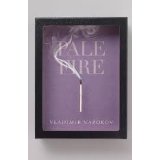
"Pale Fire" by Vladimir Nabokov

Based solely on the Table of Contents (Forward, Poem, Commentary) you might assume you're in for a dry academic study of a poet’s work. This is the book’s veneer. Once peeled away, an exhilarating story unfolds. Pale Fire is written, first person, by one Charles Kinbote, a native of Zembla, now living in New Wye, Appalachia, and a recently hired professor at Wordsmith College. Before this book is published, Kinbote rents a house from one Judge Goldsworth, who years ago had a madman named Jack Grey committed to an insane asylum. The judge is away on sabbatical when Kinbote moves in. 

Next door lives our celebrated poet, John Shade. He writes a 999-line poem he entitles Pale Fire – stirring verse full of poignant imagery, double entendres, brilliant puns and word games. (As a rule, I deplore poetry; but this is fantastic stuff.) Shade dies; the manuscript falls (you’ll learn how) to Kinbote. He writes the accompanying Forward and Commentary and finds a publisher. 

This is that book.

Initially you might think Kinbote will be the ideal critic for Shade’s poem; in the course of their budding friendship, the two minds (Kinbote alleges) became twin souls.

But our smug émigré spends more time telling us about his Zemblan homeland than about Shade’s poem. Kinbote claims that he often entertained Shade with stories about Zembla and about the revolution that led to its king’s imprisonment. It was after this that Shade began work on his epic poem, Pale Fire. For this reason, Kinbote assumes Shade’s poem would focus on Zembla. Instead, Shade wrote about life and family. Indeed, you begin to suspect Shade never intended to have the poem published! Kinbote fails to see this; he’s too preoccupied with inventing clever connections between his own vain and self indulgent telling and Shade’s verse.

The similarities are strained at best. Or are they? At times it seems Shade may have indeed buried Zemblan themes deep in his writing. Kinbote is so persuasive. Zembla’s king escapes from the bloody revolutionists, ends up in France, where, Kinbote claims one Jakob Gradus, a hired gun, is directed to find and assassinate him. 

Kinbote continues to use Shade’s poem as a springboard for an engrossing story of Zembla and its monarch, all the while, says Kinbote, corresponding to verse from the poem, if not in content, at least chronologically. For as Shade was filling out index card number 243, which would become lines 740 to 748 in canto four, the brute was boarding a plane bound from Paris to a quiet little countryside in New Wye.

The day Shade completes his poem he accompanies his neighbor Kinbote to the fellow don’s rented house, manuscript in hand, perhaps planning a toast. On Kinbote’s porch, so Kinbote says, both poet and admirer are met by Gradus, who draws his revolver, fires at our fugitive king Kinbote, but hits the genius Shade instead. This is actually Jack Grey escaped from the asylum, seeking his revenge on Judge Goldsworth. But Kinbote doesn't seem to make the connection, though he does allow that Shade resembles the judge.

Kinbote reports that he later visited the assassin in prison and that the man pretended he’d never heard of King Charles II of Zembla. Nor would he acknowledge he’d been sent on a mission to assassinate him. A thug, but a loyal thug, Kinbote decides.

But is Kinbote really a fugitive king? Does Zembla even exist? 

The book is full of literary gems and jests like these. You’ll enjoy uncovering what appears to be the façade only to discover a dream. Innuendo rushes along just beneath the lines, and once you’ve finished reading the witty Index, you’ll want to go back and do it all over again. Certainly one of the best books I’ve read. Subtle. Amusing. Brilliant.  

"Tempest-Tost" by Robertson Davies

First book in the Salterton Trilogy. I’d read book two, Leaven of Malice, first, back in November (see blog post). That was a paperback stand alone. Then nearly two weeks ago I found the whole trilogy in a thick paperbound book hiding in a bag against my bedroom wall. Didn’t even know I had it. I swear; I really need to clean my room. This stack of thirty-seven pizza boxes is about to tip over too.

Reading the books out of sequence didn’t hurt anything; the stories are self contained.

Great books are like a seduction, an intimate relationship between reader and writer. When the writer’s command of the language is sure, the reader will moisten the fingers and caress the story as it unfolds, soon “mmm-ing” and “ah-ing” as another pleasure is laid bare. Eventually the writer has the reader in the throes of a passion and an ecstasy until ultimately the reader is panting, lying naked, and in a fevered delirium!

Or is that just me?

Book three, A Mixture of Frailties, closes out the trilogy, so I’ll be reading that next. And maybe smoking a cigarette.  

Tuesday, December 13, 2011

"Oliver Twist" by Charles Dickens

Of the few classics I've read over the years, not all deserved the label. So I didn’t automatically expect Oliver Twist to be great. In fact, I’m reminded of that scene in Candide by Voltaire when a guy explains that most of the great celebrated masterpieces are merely models of mediocrity.

This time, however, I struck gold. Oliver Twist is both a classic and a masterpiece. Keep in mind that the book was written 170 years ago, so the grammar is pretty formal by today’s standards. However, the style, if not the vocabulary, grows on you, and you’re soon caught up in a riveting story chock-full of chases and abductions, villains and pick-pockets, deception and murder. Being transported to a time and a place of disease and dishonest toil may not be your idea of time well spent, but if you enjoy irony, sarcasm, and drama, overcoming terrible odds amid squalor and criminality, you’ll love this book.

Dickens criticizes early 19th century English society’s assertion that bad people are just born that way and shows how rather a combination of society and social policy are at least partly to blame. The novel’s only flaw is that this thesis doesn’t apply to everyone. For example, while we’re led to consider Nancy ultimately a victim of her environment rather than a willing accomplice, some criminals like Sikes and Monks and Fagin are seen almost as a source of evil rather than a product of it. Then there’s Oliver, who defies the paradigm altogether, since despite being born impoverished and the victim of injustice, he manages to remain almost saintly. Even while his peers and contemporaries assimilate, Oliver stays unchanged. Not particularly realistic, but forgivable in lieu of other great things this story has going for it. After all, no novel is perfect, even a classic. Highly recommended.

Friday, December 9, 2011

The Acts of King Arthur and His Noble Knights, from the Winchester Manuscripts of Thomas Malory, By John Steinbeck

The King Arthur cycle has always held a special place in my heart. Those gallant knights in shining armor, their code of chivalry, and their everlasting conquests, recall an age unspoiled by our more modern concerns. I, for one, savor a time when a knight’s word was his oath and when the chaste surpassed puberty. Give me banners flapping in the wind, animal horns sounding over the rolling green, and warriors charging into battle – their tragic ends remembered long after their dragons have been slain and their kingdoms lay in ruins. 

Everyone is familiar with the tale and the primary characters involved. Reviewing the plot isn’t important here anyway. What matters is Steinbeck’s ability to draw you into an ancient world, make you believe in events both dubious and extraordinary, allowing you to see beyond the words to the pristine pastures, the mysterious forests. But more important still are the convincing relationships – a knight’s steadfast devotion to his king, the sorrow of unrequited love, the treachery of dukes and witches.       

And such stories can be ideal instruments of insight. After all, moral tales – or stories of instruction – don’t have to be ponderous or dogmatic. Consider this sample exchange between king and enchanter, when, after a particularly bad day for Arthur (learning he’d been tricked into sleeping with his half-sister and later bested by a knight who broke his blade), he mourns to his mentor:

“You must be proud to serve me, Merlin, a defeated king, a great and worthy knight who does not even have a sword, disarmed, wounded, helpless. What is a knight without a sword? A nothing – even less than a nothing.”

“It is a child speaking,” said Merlin, “not a king and not a knight, but a hurt and angry child, or you would know, my lord, that there is more to a king than a crown, and far more to a knight than a sword. You were a knight when you grappled Pellinore unarmed.”

          “And he defeated me.”

“You were a knight,” said Merlin. “Somewhere in the world there is defeat for everyone. Some are destroyed by defeat, and some are made small and mean by victory. Greatness lives in one who triumphs equally over defeat and victory¼

At the back of the book are letters Steinbeck wrote to his agent and others as he grappled with the material. In one such letter, he remarks: “¼the Arthurian cycle¼is a mixture of profundity and childish nonsense”. And “I tell these old stories, but they are not what I want to tell. I only know how I want people to feel when I tell them.”

If this isn’t a genius defining his magic, magicians beware; magic is dead. In another letter: “Kings, Gods, and Heroes – Maybe their day is over, but I can’t believe it.” 

Neither can I.

***

Other works in the Arthurian vein

Stephen R. Lawhead has written at least six books involving the Arthurian Legend, also known as the Pendragon Cycle. I’ve read only the second book: Merlin. Richard Monoco wrote a King Arthur trilogy. I’ve read only the first two: Parsival, or a Knight's Tale and The Grail War.

If you enjoy poetry, you’ll love Idylls of the King by Alfred Tennyson. Personally, I have yet to fully appreciate poetry. Its inarticulate nature bugs me: if prose could be compared to the smooth flow of film, verse is a slideshow. Still, this was very good.    

The only series I’d really recommend, and recommend heartily, is Mary Stewart’s Merlin TrilogyThe Crystal Cave, The Hollow Hills, and The Last Enchantment. I’ve yet to find its equal. Told in first person from Merlin’s perspective. Stewart is a master storyteller. Exceptionally well written and engaging. 

Character Sketches with Paul

Paul publishes a monthly newsletter railing against successful business. He distributes these colorful works of rage to his friends. In it, he accuses CEOs of every conceivable ill – from the plight of our fragile environment to the homeless on our streets. According to Paul, it’s not media or society or government, but rather evil greedy men like Steve Jobs and Bill Gates who are entirely to blame for the decline of Western Civilization. Rather than single out indiscretions or scandals, Paul’s newsletter paints a broad brush that essentially indicts every capitalist ever to walk the earth. As far as Paul is concerned (at least according to his newsletter), these evil business tycoons are going to Hell.

Unlike his other friends, I was introduced to his newsletter first. So my impressions were shaped entirely by his prose, not his handshake or his eyes.

All his articles are in upper case, the literary form of shouting, and every sentence is punctuated by at least six exclamation points. One can almost see the spittle as he stabs at his keyboard, and I quote: “LAST YEAR ALONE THIS JACKASS MADE $$$$$$$$$$$$$$$$$…”  An additional 29 dollar signs and 14 exclamation points follow.

Apparently, Paul’s literary indignation is simply too great to contain, and I’m a little nervous about meeting him. Friends assure me that he is nothing like his newsletter in person, but I still expect a mean, angry debater. No lively discussion on capitalism versus liberalism, polyester versus cotton blend. Au contraire! I expect Paul to be packing.

Yet when I finally meet Paul, I feel as if I’m meeting the broken version of Paul – the Paul whose printer has been beaten with a baseball bat by an angry republican. No more newsletter. Paul approaches us with his head down, his chin on his chest, pale and frail and with a handshake as limp as a dead frog. He slouches at about five feet tall and looks as if he has just received news that his copy of The Communist Manifesto was stolen. The most timid man I’ve ever met. It takes me 20 minutes from the point we’re introduced to accept the fact that this calm, quiet person is the author of so much hen pecking fury.

His wife Doris, a short and plump blob of a woman, suffers from schizophrenia and paranoia. Over the years, her refusal to take her medication has forced Paul to call her psychiatrist. This in turn inevitably leads to State imposed sleepovers at a local psychiatric ward. Their relationship, while tragic from my vantage point, makes for high jinx in public settings those few times he brings her out of hiding.

“Don’t call me crazy, Paul,” his wife warns. “I’m not crazy!”

“Honey, no one’s calling you crazy.” Paul reaches for her hand and bumps the restaurant menu with his forearm. “Just tell the waitress what you want.”

“Tell her to stop staring at me first! Look at her! She’s staring at me and I want her to stop.” Doris clenches her fists. “Look! Quit staring at me.”

The thought that his wife might really be the author of the newsletter, rather than Paul, crosses my mind. She certainly seems capable of the rage. Her face is a scowl. The waitress takes a step back, her eyes bugging. Paul sighs heavily, rises from his chair like a defeated man, and tells us all he and his wife have to leave.

I’m never quite sure whether I’m cursed or blessed to share the company of freaks. On the one hand, these are not the sort I can confide in or learn from. However, their amusing, dysfunctional nature makes for exquisite writing material. The only challenge is stifling my laughter so that I don’t hurt their feelings.

Paul generally doesn’t bring his wife along to social get-togethers. On poker nights, especially, and I can only imagine she staying home staring out her windows with her fingers poised over her cell to dial 911. The image of an acorn dropping from a tree and striking her rain gutter, causing her to leap in fright, knocking over their coffee table and upsetting the Cheshire, makes me grin.

However, I could be wrong. Maybe when she isn’t curled up pensively starting at her toes in a rubber room, she’s at home watching Oprah or Real Desperate Housewives, shelling almonds and petting the cat.

After pizza, cards, and a game on TV, Paul says his goodbyes and drives home.

He returns ten minutes later, slouching in the doorway with those puppy eyes.

“What’s up, Paul? Everything okay?”

Paul’s mouth curls to one side, the equivalent of a shrug. “Yeah, just wondered if I could hang out for a while.”

“Sure, Paul. Anything wrong?”

“Nah,” he assures us. “It’s just Doris. She locked herself in the house again.”

That’s when we laugh. “No one locks herself in a house, Paul. She’s locked you out. Did you guys fight before you came over here this afternoon?”

Paul promises us that, no, she just ‘gets this way’ sometimes. I can’t help but think that while he’d been playing cards with us, she’d stumbled on his newsletter, and after counting the 267 exclamation points, she’d decided to lock the windows and dead bolt the doors.

I don’t know him well enough to ask. Gratefully, someone else asks him for me. “Why do you put up with her, Paul?”

Paul doesn’t hesitate. “I don’t wanna be alone. Don’t wanna live alone.”

I’m not qualified to say whether waking up in the morning with someone else in my bed – even if she’s crazy – is better than waking up alone. But I think I prefer solitude and sanity over matrimony and madness. In fairness, John is the proverbial kettle whistling on the stove, though I prefer to think the whistle emanates from a train barreling down the tracks. To offset his pent-up frustrations with being married to crazy, John composes his newsletter. In a sense it’s his cry for help. At the very least, it’s his punching bag. In short, John just needs to get laid.

Tuesday, December 6, 2011

Stephen King’s Bag of Bones

When I first began this blog, I promised myself I wouldn’t post negative book reviews. But what if you're inspired by the storyteller, captivated by the characters, the development of the plot – the pace, the attention to detail – what if you love all those things but just hate the story itself? Should you abstain from saying so? Probably. Still, there are so many things to celebrate about this book. I’m torn.

I tend to prefer prose so well crafted that they inspire me to call a friend and say, “Listen to this.” Granted, those kinds of books are few and far between, but I like to set high standards for others. Not for me, you understand. Just for others. Yet I didn’t find many lines I wanted to quote from Bag of Bones. Although this one I liked:

“Humor is almost always anger with its makeup on …”

In his novel, Welcome to Fred, Brad Whittington’s character Mark Cloud, now an adult, reflects on when, during his adolescence, his family moved from “metropolitan America” to the culturally stark backwoods of East, Texas:

“They dipped snuff, spitting streams like some ambulatory species of archerfish. …They split logs and infinitives, chopped wood and prepositional phrases, dangled fish bait and participles – all with equal skill.”

Another writer I love is Rick Riordan, best known for his young adult series Percy Jackson and the Olympians. However, I particularly enjoy his adult crime novels involving Tres Navarre. From his opening lines in The Widower’s Two-Step:

“The guy standing in front of my park bench looked like he stepped out of a Fleetwood Mac album cover, circa 1976. He had that Lindsey Buckingham funhouse-mirror kind of body – unnaturally tall, bulbous in the wrong places. He had the ‘Fro and the beard and the loose-fitting black martial arts pajamas that just screamed mod.”

The only other novels I’ve read by King are Misery and FirestarterDifferent Seasons was a book of short stories. As always, I admire the ease with which King weaves his yarn; I’m just rarely enthused about the finished shawl. I have no beef with King’s style per se. I guess I just don’t care much for the horror genre. The only non-fiction thing I've read by King was On Writing, a memoir of the craft, more autobiographical than instructional, but still very good.

I almost regard King's fiction as one might regard those Transformers movies. Sure, they’re fun to watch. The special effects are amazing. The actors are beautiful. But come on: it’s about oversized toys.

I acknowledge King’s appealing pedestrian tone, his everyman approach, the accessible prose. And I don’t slight him for it in the least. Mark Twain, one of my absolute favorite dead authors, once wrote: “My books are water. Those of the great geniuses are wine – everybody drinks water.”  

It’s also worth noting that I cried several times throughout this novel. Course I tend to cry at Disney films as well, chopping onions, listening to Don Henley, and much more, not all of which are inherently sad. But that’s for another post about what a sensitive man I am.  

All that aside, I realize I’m probably being too hard on King. It’s not his fault I’m not crazy about horror fiction. Not his fault I’m a prude and prefer to read highfalutin prose. A story’s primary function is to effect you emotionally. King certainly achieves this. And isn’t that why we watch movies and read novels – to be moved, to laugh, cry, cringe, rejoice? If we gain some insight, enlightenment, or wisdom along the way, it’s probably the wine.

How Learning a New Language Improves One’s Life, and other Trivia

Some things are inexplicable. For example, my desire to teach myself a second language at age fifty-two. And what, pray tell, was that secon...