Friday, May 17, 2013

The Book that Changed My Life

If it's true we are what we eat, the same must be said about what we read. Few things are as meaningful as a good book. As a source of influence, entertainment, instruction, and inspiration, books have no equal. It shouldn't surprise, then, that some go on to break our hearts and, yes, even change our lives. 

Though my own selection might strike others as obscure, these books mean enough to me that I'm willing to risk a little reproof. One influential read came recommended by a health nut, a book about nutrition, The Sunfood Diet Success System by David Wolfe, a vegan. This was back when I smoked a pack of cigarettes a day and drank scotch from the cask. It was a horrid book, poorly written, and self-published back when the term 'indie writer' was synonymous with 'conspiracy theorist'. Wolfe gave the dreaded term 'purple prose' a whole new meaning (the entire book was printed in a purple font color). But his testimony and anecdotes convinced me to give it a try. I quit smoking, lost considerable weight, impressed my doctor, and felt (physically) better than I ever had. I would've remained a practicing vegetarian were it not for the inconvenience. (Unless you enjoy cooking for one, raw fruits and veggies are your only bread and butter. That and actual bread and butter. And anything else that doesn't involve the death of animals. But try to eat out with friends and find meatless alternatives on a menu. I haven't abandoned the diet, but I cheat on the go.)
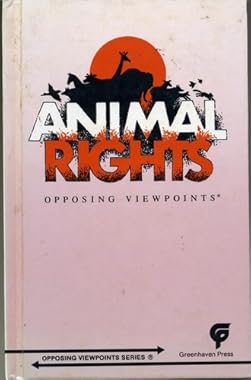
Another book that made a big difference was Animal Rights, opposing viewpoints, edited by Janelle Rohr. This was around the time I'd become eligible to vote. Animal rights was a hot button issue back then, and rather than rely on the consensus of friends and family, I'd decided to do my own investigation by reading what proponents of both sides had to say. 

The book is a collection of essays on everything from abattoirs to zoos. What intrigued me most, oddly enough, wasn't whether the ethical treatment of animals should or shouldn't involve a moratorium on hamburgers or lab rats or whaling or even whether the continuation of any of this stuff is or isn't morally right or humane, though these are certainly important considerations and worthy of debate.

Instead, what intrigued me was Rohr's principle purpose – to arm the reader with the tools essential for critical thinking. She does this by outlining basic rules of logic and summarizing some common fallacies, such as what constitutes a circular argument and how appeals to emotion and to authority, while useful and maybe legitimate, are no substitute for deduction. She then offers two essays, one for and one against, say, fur trapping, after which she asks the reader whether s/he spotted the fallacies. Another pair of essays would follow arguing for and against, say, primate research or hunting. Subsequently the reader is taught how to dissect a given argument, evaluate its merit, and determine whether it warrants the essayist's thesis statement.

I found these exercises exhilarating. It awoke in me a love for logic. Philosophy became my fetish, and I would go on to apply what I'd learned to an array of subjects.

As a Christian, I'd be remiss if I didn't at least mention the Bible as an important influence. Certainly my faith, based on the teachings in the Bible, changed my life. But, to be fair, the good book can't be considered the catalyst for my conversion so much as an ongoing resource, since my transformation began with the apologetics of C. S. Lewis, Peter Kreeft, and, to a lesser extent, Francis Schaeffer. At the risk of seeming impious, I probably owe as much to Mere Christianity, Between Heaven and Hell, and He Is There and He Is Not Silent as I do to the New Testament.

Around this time I developed a fascination for ancient civilizations and got interested in these same ancient peoples' belief systems. This is when I actually read the Bible from flyleaf to flyleaf, as well as The Upanishads. This in turn got me interested in world mythologies, Edith Hamilton's great work Mythology chief among them. And this indirectly bled into a passion for legends of antiquity, folk tales and the like.

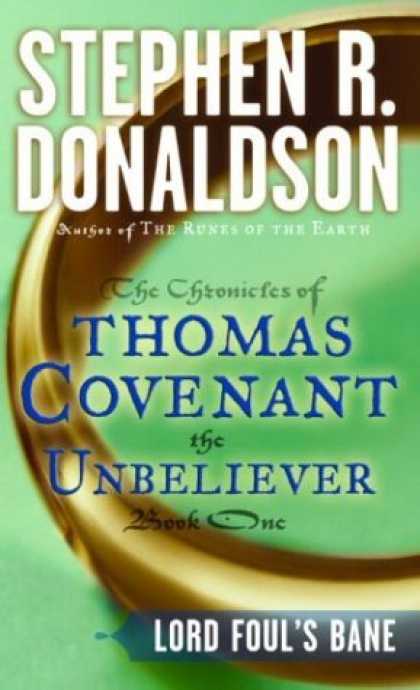
Contemporary fantasy fiction was the next step in my literary journey. That year a friend introduced me to Tolkien's Hobbit and Lord of the Rings, George MacDonald's pair of Princess tales, and C. S. Lewis' Narnia Chronicles. Shortly thereafter, I'd reached the bottom of the book bin, reading mostly poor grade fantasy fiction by some popular but mediocre writers. I asked a well read friend whether he knew of any epics comparable to Tolkien's Rings trilogy he could recommend. The result was Stephen R. Donaldson’s extraordinary novel Lord Foul's Bane from The Chronicles of Thomas Covenant the Unbeliever.

This dark, controversial story altered my ideas about conscience and culpability. The protagonist's deeds and the subsequent complications that ensue impacted me like no other work of fiction before or since.

You can find hundreds of reviews of the novel on amazon here and a stellar examination of the plots, themes, and implications of the entire Chronicles on wikipedia here.

SRD has a unique, intense style. Everything is told in a tone verging on violence. There's a sense of urgency throughout. I've yet to find a novelist who explores the psychological turmoil of his characters with such energy and conviction. His approach exemplifies the intrinsic power of the written word. 

If any book can be said to have changed my life, it's this one. Reading Lord Foul's Bane made me want to write. Artistic expression wasn't new to me; I'd been a musician since my early teens. But only now did I consider words as evocative as music. Over time, my muse sang less and whispered more. Melodies were replaced with story ideas. I've been writing ever since. 
Wednesday, May 8, 2013

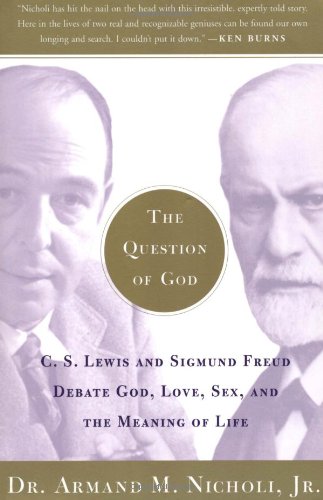
The Question of God; C.S. Lewis and Sigmund Freud Debate God, Love, Sex, and the Meaning of Life, by Dr. Armand M. Nicholi, Jr.

For over half a century, the work of these two pioneers has influenced millions. Yet their ideologies were diametrically opposed. Freud assumed the Judeo-Christian God didn't exist. He based his entire life's work on the premise that the supernatural was at best untenable; until Lewis' conversion, he too held that belief. Then he became a Christian. This changed his worldview. He embraced God's love, meaning, hope, ideas and values Freud, incidentally, regarded as delusional.

The Prologue opens with their funerals – a couple of quotes from attendees, snippets and summaries from their obituaries, and a brief montage of their accomplishments. A tasty appetizer to prime the palate for the entrée to come.

The lives of these two intellectual icons overlapped in both space and time: Freud lived “not far from Oxford” where, and while, Lewis was a young professor, and the two were separated only by a generation; Lewis' body was buried just 24 years after Freud's was cremated. Both wrote passionately and extensively about their philosophies, and the two shared an interest in literature and psychoanalysis. They published several books, including autobiographies.

Nicholi sets out to address two fundamental questions “What should we believe?” and “How should we live?” He examines Freud's and Lewis' childhoods, their relationships with their families, the historical events that impacted their personal and professional lives, and the philosophies they espoused based not only on their published works but on the less public thoughts contained in the journals they kept and the hundreds of letters they wrote to friends and family. More (maybe most) importantly, the writer explores whether these men practiced what they preached, and, subsequently, whether their lives were enriched.

Both Freud and Lewis experienced heart wrenching tragedies and deep sorrows. Nicholi draws from their letters to expose these wounds. Their deaths near the close of the work, though anticipated, came too soon and made me scrunch my face and clumsily wipe my cheeks.

Detractors have expressed displeasure with Nicholi's conclusions. Some insist the pairing of the two men is unfair to Freud, that Nicholi stacks the deck against atheism, that instead Lewis should've been pitted against the likes of Sam Harris or Carl Sagan.

These objections ignore several factors, some I've already mentioned. Maybe most relevant is what Nicholi says in the Prologue:
Wherever Freud raises an argument, Lewis attempts to answer it.
Thirty years before the publication of this book in 2003, Harvard invited Nicholi to teach a course on Freud. He has been teaching the undergraduates there ever since, as well as the Harvard Medical School students for at least a decade. Initially, the course consisted exclusively of Freud's philosophical views, but as Nicholi writes:
Roughly half my students agreed with him, the other half strongly disagreed. When the course evolved into a comparison of Freud and Lewis, it became much more engaging, and the discussions ignited.
We should also remember that Freud gave us “terms such as ego, repression, complex, projection, inhibition, neurosis, psychosis, resistance, sibling rivalry, and Freudian slip.” Lewis was “perhaps the 20th century's most popular proponent of faith based on reason” and inspired a “vast number of ... societies in colleges and universities”.
During World War II his Broadcast talks made his voice second only to Churchill's as the most recognized on the BBC.
It's difficult to downplay “the sheer quantity of personal, biographical, and literary books and articles on Lewis” published since his passing.

Despite Sagan's highly entertaining Cosmos series, his important work in astronomy and astrophysics, as well as his compelling commentary as it pertains to cosmology, his influence doesn't compare. As for Harris' haphazard reasoning and saccharin science, anyone who believes this atheist would stand a chance against the likes of Lewis is engaged in wishful thinking. A brief sampling of online video or audio debates between Harris and a number of theist philosophers and scientists confirms this. Critical thinking is not his forte.

I can't imagine a skeptic coming away from this work still convinced atheism has anything attractive to offer. Freud's philosophy led to fits of depression and repeated thoughts of suicide; Lewis' faith resulted in personal fulfillment so that even at his most desperate and lonesome hour, he discovered not only an alternative to despair but a joy that surpassed his expectation.

A compelling account of two legends, their legacies, and the implication and consequence of their philosophies. Well written and researched (40 pages of notes and bibliography).

Wednesday, May 1, 2013

The Merriam-Webster Dictionary of Quotations (1992)

I have an aversion to driving in the rain. Reduced visibility, lightning, the risk of hydroplaning  these things make me nervous. But years ago, I braved a Texas summer thunderstorm despite these obstacles. I was on a quest for a book of idioms, and being on a quest romanticizes life's challenges, emboldens the adventurer. At least that's what I told myself.

The rain smacked my windshield like pellets. Lightning flared like a heliarc. But I drove on. I finally pulled into the unpaved parking lot of my local library, shut off the engine, and listened to the terrific kettle drum solo on the roof of my Taurus. I wondered whether I should wait for the concert to end before sprinting the sixty yards from my car to the main entrance. Sensing the onset of a migraine, I bolted.

The rain struck my umbrella like a fusillade as I splashed along the sidewalk. Beside me, the heavy traffic eased forward, headlights blazing, creating the appearance of a funeral procession.

If my dash to the doors had caused me to overlook the early afternoon's preternatural gloom, I couldn't miss it now; the 
library's main entrance, a huge multi-pane glass facade, swelled like a reactorIt was as if the sun, having fled the sky, had found refuge within the bowels of the building. Ads, posters, and schedules taped against the inside of the glass facing out were illumined like lampshades, made semi-transparent by the brilliance beyond.

I pushed past the waist-high turnstile and rushed to the reference desk. That's when I noticed I'd already tracked half a dozen figure eights of unpaved parking lot mud across the linoleum. I returned to the commercial entrance mats and pawed them with my sneakers like a bull preparing to charge as thunder slammed the building and sent the fluorescent lights into arrhythmia.

I never found that book of idioms, but I
 did grab four hardbound volumes featuring everything else from epigrams and aphorisms to proverbs, bon mots, and toastsThe quaint quartet was part of a set called Complete Speaker’s and Toastmaster’s Library, and today, all these summers later, I can't help but consider the contrast between those and this more recent read, Merriam-Webster Dictionary of Quotations, which seems so quarrelsome by comparison. 

Looking back on those four volumes, a symbiosis of sentiment seems to have pervaded. It was as if the composers of each entry all shared the same sensei. I remember imagining those authors and orators at some highbrow dinner party, rapping their champagne flutes with their spoons, clearing their throats, and affirming what everyone else in attendance regarded as true, the unique rhythm and timbre of their voices being the only real disparity. I'm sure the distance of time, from this moment to those many summers ago, morphs mobs into choirs, but I elect to cherish this fond fiction, if it is indeed a fiction, until some snooping statistician proves me wrong.

In contrast, wordsmiths from Merriam-Webster Dictionary of Quotations are more likely to incite a food fight. Regarding Beauty...
What is beautiful is good, and who is good will soon also be beautiful.” - Sappho
It is amazing how complete is the delusion that beauty is goodness.” - Leo Tolstoy

Body and Face...
How idiotic civilization is! Why be given a body if you have to keep it shut up in a case like a rare, rare fiddle?” - Katherine Mansfield
If anything is sacred the human body is sacred.” - Walt Whitman

Optimism and Pessimism...
The optimist claims that we live in the best of all possible worlds; and the pessimist fears this is true.” – James Branch Cabell
I came to the conclusion that the optimist thought everything good except the pessimist, and that the pessimist thought everything bad, except himself.” – G.K. Chesterton

I've got only two complaints. While I oppose the ad hominem, I take exception to known subverters and tyrants. I'll abide Timothy Leary, Machiavelli, Nietzsche, even Carl Marx, but why quote Fidel Castro, Stalin, or Mao Tse-Tung? Incidentally, those last two villains, though featured in the book, aren't listed in the Index. Conversely, the humorist Fran Lebowitz, while indexed, isn't featured in the book. 

Here a better writer would insert a pithy remark about how recording the deeds and declarations of moppets and mass murderers is perfectly acceptable for biographies, encyclopedias, and history books but shouldn't appear in a tome whose subtitle reads 4,000 thought-provoking quotations from the world's most celebrated men and women. Personally, I'd prefer they be consigned to a grimoire entitled The Infamous Drivel of Communists and FascistsRegrettably, despite my inordinate exposure, I'm incapable of crafting such a pithy remark.

Sunday, April 21, 2013

Endless Vacation, by Brad Whittington

Brad and I go way back, but don’t hold that against him. He’s a solid writer, and for the purpose of this review, that’s all that matters. Plus, it really boils down to his word against mine. So he has an out.

I always look forward to his latest projects. Of his novels thus far, Endless Vacation is his best yet.

For those who follow my blog, it won't surprise you to read that I prize convincing characters, similes that smile, and metaphors that epitomize the things described. But if plot is your thing, you won’t be disappointed, either. The twists are as intricate as an angler’s triple knot.

Writers are cautioned against creating flashbacks since such devices can potentially slow down a story. In Whittington’s deft hands the transitions are seamless. The characters’ past experiences are always perfectly placed, brief, smooth, and character driven. By the time I realized I was peeking into someone’s childhood, I was brought back to the present with a richer understanding about his or her motivation.

We’ve all read stories with engaging plots, well fashioned prose, and memorable characters. But how rare is it to find a novel that satisfies all these appetites? Brad doesn't just write a story worth reading; his stuff deserves repeated readings, which is the mark of a good writer.

A note about the brothers Davison and Hensley: in a recent phone conversation, Whittington assured me that my love for Hensley and my dislike of Davison is less than unanimous. In response, I chose to breathe heavily over the line until I was sure Brad had hung up. Obviously, my own impressions of the characters reveal more about me than about the writer’s intent. Still, without spoiling things for the uninitiated, I decided to examine why I consider Hensley the champion of the two.

Hensley's unorthodox choice of lifestyle calls to mind those I’ve known and held in high regard for their courage and their independence. I tend to give such creatures a pass when it comes to their quirky traits others might characterize as annoying, since they, like Hensley, tend to be passionate about their worldview and somewhat infectious. Granted, personalities like Hensley are eager to offer unwelcome advice, but I’ve always found this amusing, at least in moderation. Hensley in no small measure is the shining knight on at least one occasion. While his purpose isn't always noble, I think a certain deed within the story more than compensates for at least one of Davison’s grievances against him.

Which brings us to Davison, who, in contrast, reminds me too much of those who’ve reached an economic plateau without ever having questioned the route taken or the ease with which they achieved it. I’m not suggesting those whose aspirations end with death and taxes are dull. Let’s just say I’m not surprised such a man lacks interpersonal skills and that his resentment toward the one person who didn’t pamper him as everyone else seems to have done doesn’t reflect well on his alleged virtue. I don’t begrudge Davison his good fortune. But I’m glad when he finally acknowledges the good in his brother and the flaws in himself.

Saturday, April 13, 2013

Speak, Memory (An Autobiography Revisited), By Vladimir Nabokov

My first exposure to Nabokov was in the poorly lit library basement of a local community college I attended a quarter century ago. A handful of his novels stood squeezed against one another on an overstuffed shelf – Pnin, Transparent Things, Glory, The Defense, Look at the Harlequins, Despair. The row reminded me of a three dimensional bar graph. Invitation to a Beheading, dwarfed by the others, represented profit losses in March; the taller bronze one right of it titled Laughter in the Dark stood for gains in April. The titles along the spines ran sideways so that, clumsily, I found myself, as if in some stretching exercise routine, leaning from the hip, craning my neck until my ear nearly touched my shoulder.  

A month before, a friend had recommended the author’s most famous, or infamous, novel Lolita. Based on the subject matter, I vowed to avoid that book. But the promise of impressive prose made me tug a random copy (a collection called Tyrants Destroyed and other stories) from its perch, and within seconds of the first clever line, I’d escaped the dank tomb-like library basement and fallen into a web of words so wondrous I lost track of the waning afternoon until closing time when the lights went out and the shelved catacombs closed in. I thumbed my Bic lighter (I smoked back then) and used the tiny torch to find the stairs and eventually reach the counter for checkout.

It wasn’t the morbid subject matter that interested me, nor the depressing characters and their self-destructive urges. In fact, those things were sometimes cringe-worthy. But the prose! Dizzying chains of sheer delight and wonder, perfectly crafted phrases invoking incredulity and joy, awe and gratitude, not unlike the sensation one feels listening to or reading the rousing speeches of some of our greatest political leaders in times of crisis: Lincoln, Churchill, MLK.

As I’ve said elsewhere: It’s not the plot but the writing that’s a marvel. Nabokov could dwell on squirrel poop and it would read like sheer poetry. I confess: for many years, I entertained a sort of hero worship for the man. I remember somewhat facetiously confiding in a dear friend and fellow Nabokov fan that the only reason I didn’t regard Nabokov as a god is because gods can be impugned. If you’re moved by the magic of a master and his prowess with language, then you too might fall prey to idolatry as I did those many years ago.

Putting this post together, I struggled to find some choice quote I could pluck from the garden and offer as evidence of his genius, but every line was part of a bouquet. Snapshots of a sunset fail to capture the sensation of that warmth on one’s face. Instead, I’ve resolved to return to that moment a quarter of a century ago, this time creating my own artificial dark by shutting my eyes, jabbing a random page with my forefinger, and copying the line printed above my nail.

“… a chair of thin iron, with its spidery shadow lying beneath it a little to one side of center, or a pleasantly supercilious, although plainly psychopathic, rotatory sprinkler, with a private rainbow hanging in its spray above gemmed grass …”

If I hadn’t read Speak, Memory this month, I would’ve assumed my youthful infatuation had been just that. But a quarter century later and approaching fifty, I realize I’m just as spellbound today. Nabokov’s approach is infectious, and despite my efforts to escape his influence, I catch myself channeling his charms, probably in an effort to invigorate my own prose. Unfortunately, my skills are an inferior mimicry of the master. I’m like that boy who tries to lift his father’s dumbbells or that rodent apprentice donning the enchanted conical hat in the magician’s absence. I just hope I can discern my own voice amid the many I admire and enjoy which sometimes threaten, by sheer virtue of their craft, to crush my own. 

Thursday, February 28, 2013

Arilla Sun Down, by Virginia Hamilton

Pretty good young adult fiction. Arilla is the younger sibling of an interracial couple. Her father is Native American, or Amerind, while her mother is African American. Set in the 70s, the family attracts unwelcome stares in public, but Arilla’s primary plight is lacking a sense of identity. She doesn’t relate to her peers, and what few friends she has is due to her mother’s profession – she teaches dance to the girls in the community. Her older brother Jack Sun Run’s popularity grates on her; he embraces his Native American roots and celebrates its more romantic elements by riding his horse nearly everywhere, wearing a bandana, and expertly using a lasso. The young men envy him and the girls fawn. In contrast, Arilla feels inconsequential. Her brother calls her Moon, and while fitting, the name annoys her. 

What appealed to me most throughout the story was, ironically, the very thing that initially turned me off. Arilla recounts her youth with a writing style that reflects her age, meaning the opening scene and the entire first chapter is from the POV of a six year old.    

Late in the big night and snow has no end. Taking me a long kind of time going on the hill. Would be afraid if not for the moon and knowing Sun-Stone Father is sledding. Way off, hear him go, “Whoop-eeeee!” Real thin sound, go, “Whoop-eeeee!”

This style evolves so that by the time Arilla is 12, not only is the obnoxious staggering syntax of her six-year-old self gone, but the patois of her prose has become endearing and more engaging. Jealous of her brother’s charms and determined to demonstrate her own skills with the mare she received as a birthday present, she smarts off to her older brother:

          I’m about to burst into crying … But instead I laugh, short and sweet. “Call me whatever you like, ugly brother, but guess what? I’ve got her running to me when I clap my hands!”
          “My, my,” he says. “Just like that, you got her turned into a puppy dog.”

Hamilton, who’s won several writing awards, evidently enjoys a challenge. Her approach is unorthodox, like the family described. And the narrative fluctuates as she reminisces. Later, by Chapter 11, Arilla expresses her anxiety on her first bus ride.

We had started out on this old two-lane, which probably wouldn’t have been such terrible bad news on any average dry day. But this morning it was black and sleet with wet. It was snowing again and I had visions of us hitting this streak a ice and going into one of those long, horrible skids that end in an explosion. 

Three-quarters into the story, during a terrible storm, she and her brother Jack Sun Run are horseback riding when he has an accident. Arilla seeks help, ultimately saving his life. This event changes the dynamic of their relationship. She’s no longer eclipsed by him. He stops calling her Moon. As he recuperates in half a body cast, he admits as much.

          “We really aren’t enemies,” he says. Then, real quick: “But you did something more or less remarkable. So what’ll we call you – Girl Who Saves the Sun? Or Rides the Horse Fast? What name do you want?”
          I’m sitting there with my mouth open. And knowing the name but I don’t want to say it.
          …“So. You already have one,” he says. “So what is it? Come on, you can tell me.”
                    “If I did, you’d just have to laugh,” I say.
          “I won’t laugh, promise,” he says. “Because this is very important stuff.” And not a hint of teasing. “You know it,” he says. “This is no joke.”
                    Arilla Sun Down. But I won’t say it.

Arilla returns to the place where, as a child, she and her father, sledding, had almost plummeted to their deaths. In the interim, a fence has been built along the chasm. Now, more comfortable in her skin, she finds some reconciliation with her family and her adolescence. Recommended.   

Thursday, February 21, 2013

Philosophy Digestibles

Plato: The Trial and Death of Socrates, Four Dialogues, edited by Shane Weller. Socrates (469 BC - 399 BC), like any noted philosopher, had his protégés. Chief among them was Plato. In fact, without Plato’s writings chronicling his mentor’s ideas and approach, Socrates’ contributions would not have survived. To this day, his famous Socratic method is an invaluable technique for understanding the essentials of any intellectual or moral dilemma. Socrates is famous for the line ‘The unexamined life is not worth living.’ He stressed the value of reasoning through the important things in life to determine truth.

As the title implies, the book focuses on Socrates’ ideas (four dialogues), which went against the authority of the state of Athens. This led to his imprisonment and his death. His devotion to logic shouldn’t deflect from his humanity. His love for reason, beauty, and justice was astonishing. I wept when he drank the deadly hemlock and paced his cell before his legs gave out.

Critiques Of God; making the case against belief in God, edited by Peter Angeles. This is a book of essays from some of the more renowned skeptics of the 20th century. Bertrand Russel, Erich Fromm, John Dewey, Michael Scriven, and many other noted men of letters offer objections to faith in the God of western religions (Christianity, Islam, Judaism) – objections that range from thought provoking to moronic. For example, one point against the famous design argument is that since the universe is full of color, the theist, in addition to concluding that there is a Grand Designer, must also conclude that there exists a Grand Colorer, and because this title strikes the essayist as silly, the entire design argument should be jettisoned. This type of objection to faith reminds me of an argument I ran across recently by an atheist who rhetorically asked, “If we humans are so important to God, why did it take Him 16 billion years after the Big Bang to finally get around to creating us?” One might be inclined to answer that question with another one. “Would God’s existence be more palatable if He’d created mankind only three billion years after the Big Bang instead?” These kinds of objections strike me as insincere. Regardless whether you’re seriously seeking answers, already truly believe, or have genuine reservations about faith, you deserve better questions than the dismissive rhetoric found in much of the new atheist’s repertoire.

I was an atheist for over a decade. The irony being that during those years of skepticism regarding all things religious, I, like every contemporary atheist I’ve since met and debated, believed all sorts of things I had little or no evidence to support. I embraced innumerable assumptions that failed to withstand the scrutiny of either a cross examination in a court of law or the rigorous demands of a clinical study. Yet when it came to extending that same courtesy to religion, I assumed the stance of the Pyrrhonist, questioning everything but my own name and filing for a dismissal on the grounds of insufficient evidence before the case could even come to trial.

This is the inherent contradiction all atheists suffer, or at least those I’ve known, read from, or debated, namely the belief that only the scientific method can prove anything, as if only those things demonstrable in either a lab or a court of law are meritorious. This begs the question: what standard does one use to determine that the scientific method is the only viable method for determining truth? Is there an independent scientific method to determine that? And why does the skeptic assume that science’s silence regarding the supernatural somehow negates the supernatural? This is like saying the production of cotton and silk disproves the existence of sheep since wool isn’t required for the manufacturing of those materials. Besides, this implies that before the invention of the scientific method, nothing could be known or stated with any certitude. So much for experience and reason.

How To Think About God, a guide for the 20th century pagan, by Mortimer J. Adler. Written in terms as simple as the field of philosophy allows, Adler foregoes mysticism, faith, and science, throws out all the cosmological arguments of his predecessors such as Aristotle, Anselm, and Aquinas and uses nothing but strict rationalism to prove the existence of God beyond a reasonable doubt. More intriguing still is that Adler, throughout most of his career (including the years he wrote and published this book), was a non-believer.

How Learning a New Language Improves One’s Life, and other Trivia

Some things are inexplicable. For example, my desire to teach myself a second language at age fifty-two. And what, pray tell, was that secon...