Thursday, June 26, 2014

The Problem of Pain, How Human Suffering Raises Almost Intolerable Intellectual Problems, by C. S. Lewis (published 1940)

As I've mentioned elsewhere, many years ago I was a self-professed atheist. Yet I considered myself open to opposing views. It was in this spirit of open mindedness I accepted a short work a friend and mentor loaned me called Mere Christianity, by C.S. Lewis. Directed to skeptics who seek intellectual reasons for faith, it forced me to question my disbelief. It would be another decade before I squashed my pride, confronted its truth, and converted. (Guess I wasn't so open minded after all.) But that's another story that deals more with the heart than with the head.

I'm convinced that Lewis' conversion from atheism to Christianity contributed to his insight and argumentative powers. Such converts, whether it's the great economist Thomas Sowell (having first been a Marxist before embracing capitalism), tend to speak and write with more authority than those who carry the same political or religious views from cradle to coffin.

I'm not suggesting converts ipso facto make for persuasive writers. Nor does doing an ideological about-face necessarily mean one is more objective or sincere than the next guy or gal. But a lot can be said for having not only examined and lived opposing doctrines but articulating what precisely changed one's mind.

Lewis begins The Problem of Pain with the strongest case for atheism I've ever read. In fact, ironically, I haven’t come across a more compelling argument than the one this former atheist poses. Lewis then goes on to show how such an argument is not only too simple but self contradictory.

The Problem of Pain isn't a self-help or how-to-grieve type work. Nor is it for everyone. Those who lack faith in God or a fundamental knowledge of theology will be as lost as the student who skips basic math and jumps straight into physics. This is for people of faith who want rational answers to perhaps the most challenging question facing believers – why we suffer.

It's no wonder fifty years after his death, Lewis is still widely regarded as the preeminent standard-bearer for apologetics. He's a thoughtful, articulate, persuasive writer, and reading this book made me want to be a better Christian. That alone should recommend it to fellow believers.

Wednesday, June 4, 2014

Tropic of Cancer, by Henry Miller

We've all known our share of walking rain clouds. Happily for me, those relations never lasted. Sure, I'll be the first to acknowledge the world is full of cruelty and corruption, but I'd rather celebrate the good than bemoan the bad. To fixate on the tragic, or worse, to claim only the brutal and the vulgar constitute all there is to life, is not only shortsighted but makes for a grim personality, not to mention a depressing read.

First published in Paris in 1934 and subsequently banned in the U.S. until 1961, Tropic of Cancer charts Miller's experiences among the French bohemians during the early '30s. Full disclosure, I served in the U.S. NAVY. I've seen it all. Hell, I've done more than I'd confess to in mixed company. Still, Miller's attitudes and indulgences easily exceed my humble excesses. Such lapses in judgment were the stage dressings of my experience, not the main attraction. For Miller, it's the other way round. His chronicling of coitus, fellatio, cunnilingus, menstruation, flatulence, and defecation makes for the sort of work an exhibitionist or performance artist might compose on a dare. Termed 'autobiographical novel' (which I'm told is a genre), this book, rather than simply pushing the envelope for obscenity, laces the envelope with Ricin and sets it on fire.

In fairness, the average vocabulary is small enough without us banning words or censoring writers. So I'd never call for a moratorium on terms or demand someone's silence for uttering inflammatory language. Indeed, one of the bonuses to free speech is giving fools a forum to unwittingly identify themselves. How else will the rest of us know to avoid them? I'll defend this writer's liberty to voice his drivel until the angry birds come home.

Besides, I don't object to the obscenity so much as the hatred. Miller uses the Inn word to refer to knee grows, calls nearly all women cunts, has nothing but contempt for The Jews, and in one passage, writes, “... because every now and then I meet little yellow men from Cochin-China – squirmy, opium-faced runts peeping out of their baggy uniforms like dyed skeletons packed in excelsior.”

A third of the way into the book the curtain falls utterly.

Hello! Are you Henry Miller?” It's a woman's voice. It's Irene. She's saying hello to me … For a moment I'm in a perfect panic.

As a reader, so am I. Henry Miller the writer and Henry Miller the protagonist are one. This struck me as problematic since Miller, or at least the Miller Miller represents, never fails to ridicule his bohemian friends, pointing out how depraved, lost, hopeless, and foolish they are – all the while both demonstrating the same depravity and relying on their sporadic charity for his livelihood.

The madness doesn't end there. In an interview, Miller said he dabbled with the title Crazy Cock. As to why he settled on the published title:

...to me cancer symbolizes the disease of civilization, the endpoint of the wrong path, the necessity to change course radically, to start completely over from scratch.”

If civilization is diseased as Miller tells us, if we must start over as he says, I assume these pronouncements are an indictment on human behavior, hypocrisy, and the like. So what remedy can we expect from cataloging characters with lice? Throughout the book, not an insect escapes Miller's eye. Every louse and cockroach is commented on. Rats make frequent cameos too. And what precisely accounts for his hostility toward birds?

Every time I pass the concierge's window and catch the full icy impact of her glance I have an insane desire to throttle all the birds of creation.

When toward the end of the book Miller has an opportunity to do a good turn, he takes the low road, betrays a friend's trust, and, perhaps worst of all, has no moral qualms whatsoever about doing so.

If you don't mind reading what could essentially pass for alcohol-induced exchanges between sexually frustrated college frat boys or dictation taken at a cocaine laced swinger's club, or, better yet, if you're encouraged (as one Amazon reviewer promised) reading the rants of a foul, self-absorbed, male chauvinist, racist leech who resents those whose help he needs most while simultaneously depicting them as degenerates, you might have a more favorable impression of this depressing read. For me, the line between constructive criticism and wanting to burn the whole world to the ground is not so fine or gray. It's the difference between the sage and the serpent.

Wednesday, May 28, 2014

The Silmarillion, by J.R.R. Tolkien

I tried to immerse myself in this tome of pseudo lore after reading The Lord of the Rings trilogy for the first time nearly thirty years ago. Fantasy fiction was my genre of choice back then. Still, I couldn't do it. Middle-earth's creation story, which kicks off the book, felt as dry as a Texas summer drought, and by chapter two my thoughts had wandered off to swimming holes and cold beers. I set the book aside for stories featuring plots and protagonists, intending to one day return to this unfinished, posthumous, literary geekfest when my constitution could endure the myriad cameos and daunting pronunciations of foreign place names.

Years elapsed. In the interim, I was exposed to the likes of Twain, Nabokov, Steinbeck, Greene, and Davies. Over time, my concerns shifted; I developed an appreciation for style. Craft superseded genre. Plot was reduced to its essential ingredient, like flour or stock, but no longer the dish's draw. In short, what happened in a story became secondary to how what happened was conveyed.

A film major once directed my attention to select camera angles and lighting effects and how these shots were used to induce attitudes in the audience. We were exploring the mechanics of movie making, occasionally to the detriment of the dialogue. How the clock worked became more engaging than what time it was.

Whether this shift in concern is a good thing is debatable. Learning the mechanics of story – how to create memorable characters, evoke emotions, and sustain tension – can certainly benefit the aspiring writer. But it can spoil the reader, just as I suspect a flower's bloom to a botanist isn't quite as pronounced as to a mom on Mother's Day.

This clinical approach to reading has in many ways hardened me. I'm more demanding, more selective, than I once was. As a result, I rarely read fantasy fiction anymore. Most of it is elevated comics, of little or no redeeming value.

However, two hundred thousand words into my own magnum opus involving knights and knavery drew me back to the more contemporary authors of the genre if only to appraise the market. And since most of it (without naming names) ranges from mediocre to poor, I decided to return to the master.

Revisiting The Silmarillion while focusing on style alone dramatically improved my experience. The book's lack of structure – its numerous, sometimes disjointed, accounts of elves and oaths and betrayals and battles – was no longer a distraction. Instead, the words, though a vehicle for such things, became the primary character, much like Middle-earth itself is arguably the primary character of The Lord of the Rings.

Few contemporary fantasy fiction writers have Tolkien's ear for that diction we associate with a bygone era. Stephen R. Donaldson is the only other writer I know who has achieved a similar authenticity. A philologist as well as a lover of epic poems and ancient lore, Tolkien convincingly reproduces the archaic speech patterns we associate with the nobility of yesteryear.

“And among these I hold trees dear. Long in the growing, swift shall they be in the felling, and unless they pay toll with fruit upon bough little mourned in their passing. So I see in my thought. Would that the trees might speak on behalf of all things that have roots, and punish those that wrong them!”

A grandeur abounds in the narrative as well, often inspired, and reminiscent of Homer's Iliad.

But at the last the might of Valinor came up out of the West, and the challenge of the trumpets of Eönwë filled the sky; and Beleriand was ablaze with the glory of their arms, for the host of the Valar were arrayed in forms young and fair and terrible, and the mountains rang beneath their feet.

With the help of J.R.R.'s son Christopher Tolkien, The Silmarillion summarizes the creation and the early history of Middle-earth, namely the First and Second Ages, which are, for those keeping score at home, the events prior to The Hobbit and The Lord of the Rings trilogy. This isn't a novel. Nor is it a book of short stories. Though a book of short stories comes closer to the mark. Historic events and the key figures involved are given chapters. A few figures reappear in later chapters. Most don't. 

Still, the book has several superb passages. After establishing Melian as a Maia (a sort of demigoddess) whose singing draws the nightingales to flock and follow her, we're introduced to Elwë, later known as Thingol, one of the three chieftains of the original elves, who stumbles upon Melian singing in her garden.

… being filled with love Elwë came to her and took her hand, and straightway a spell was laid on him, so that they stood thus while long years were measured by the wheeling stars above them; and the trees of Nan Elmoth grew tall and dark before they spoke any word.

For those who rejoice in good style and find themselves disappointed by many of the more contemporary fantasy fiction writers, this work won't fail to delight, despite its hodgepodge construction. Recommended for the connoisseur of good prose; not for the gourmand of plot. 

Monday, May 19, 2014

Wuthering Heights, by Emily Brontë

Books written in the elevated prose of 19th century English literature have a certain charm. If you can get past the tuberculosis, syphilis, dysentery, kissing (and marrying) cousins, the writing, with its somewhat stilted syntax, has a certain seductive quality. Its graceful grammar, even the vocabulary, appeals to me in ways I can't really define or defend.

Partially due to my age, partially due to my love of language, I have a tendency to sound like a stuffed shirt when I should don the prose equivalent of the casual pullover. I'm inclined to receive when I should get, speak instead of talk. In casual conversation, I still distinguish can (what is possible) from may (what is allowed). And don't get me started on will and shall. Incidentally, this might explain, in part anyway, why I love reading Wodehouse and watching British comedies. Or maybe it's the other way round; spoiled on the stirring elocution of poets, I dread the brute with the bullhorn.

For whatever reason, the snob in me balks at the attitudinal contrast from yes to yeah; pardon? to huh?; perhaps to pfft; maybe to meh. And it's this difference, this speaking with authority versus sleepwalking, that stirs something within me to reject the limp tongue for the limpid. Call it indigestion. Blame my mother for blaring vinyls of Mozart and Beethoven to a babe confined to his crib, but this literary fetish, for good or ill, is real, and I'm happiest when well fed.

Wuthering Heights was published in 1847, so it's steeped in the prim prose of that era. Planted in the Yorkshire moors, northern England, the story recounts the stark and tragic lives of two generations of families, related by way of a literary gimmick. You've probably seen it before. A protagonist walks into an inn and is treated to a fireside chat; or a wounded, bedridden soldier or sailor recuperates in either a private or military hospital and spins a yarn for his physical therapist; or an officer with too much free time tells a tale the patient patiently dictates. Whatever the relationship, whether Donaldon's “Ser Visal's Tale” or Conrad's Lord Jim, such stories depend upon both the impeccable memory of the narrator and the formidable stamina of the author who must inevitably postpone trips to the loo and often fast for the duration.

I celebrate artistic license. I'm a great practitioner of suspending disbelief. But in Heights, we see this gimmick in almost exaggerated form. Detailed exposition, as well as reams of dialogue no one could possibly recount with such precision decades after the events have unfolded, are conveyed by the housekeeper as if she were reading directly from her diary. This tests both the patience and the credulity of the reader.

For those who consider this novel a love story, I would ask them to disavow this notion and remember love's lesser, though more seductive, siblings: infatuation, lust, and obsession. A critic expressed a similar sentiment about Lolita, claiming it was perhaps the most convincing love story ever written. Lest we forget, love isn't abusive or callous. Those are corruptions of love. At its heart, love is a virtue, not a vice. The feelings or emotions that accompany love are not love itself but rather reflections of it, like the sun's light illuminating the moon or the flavor of food rather than the nourishment itself. Love is commitment, devotion. It inspires oaths. We sacrifice what we want for the needs of those we love. Neither Lolita nor Wuthering Heights would recognize love in its pure form. Instead, those books describe relationships depraved and detrimental to the parties involved.

Despite my praise of the prose, this is (spoiler alert) a tragedy. If you enjoy soaps – stories in which the villains suffer no more than their victims throughout – then you might enjoy this drama. If, on the other hand, you lament the absence of goodness or justice in fiction, you should give this classic a pass. Recommended but with reservations. 

Friday, May 17, 2013

The Book that Changed My Life

If it's true we are what we eat, the same must be said about what we read. Few things are as meaningful as a good book. As a source of influence, entertainment, instruction, and inspiration, books have no equal. It shouldn't surprise, then, that some go on to break our hearts and, yes, even change our lives. 

Though my own selection might strike others as obscure, these books mean enough to me that I'm willing to risk a little reproof. One influential read came recommended by a health nut, a book about nutrition, The Sunfood Diet Success System by David Wolfe, a vegan. This was back when I smoked a pack of cigarettes a day and drank scotch from the cask. It was a horrid book, poorly written, and self-published back when the term 'indie writer' was synonymous with 'conspiracy theorist'. Wolfe gave the dreaded term 'purple prose' a whole new meaning (the entire book was printed in a purple font color). But his testimony and anecdotes convinced me to give it a try. I quit smoking, lost considerable weight, impressed my doctor, and felt (physically) better than I ever had. I would've remained a practicing vegetarian were it not for the inconvenience. (Unless you enjoy cooking for one, raw fruits and veggies are your only bread and butter. That and actual bread and butter. And anything else that doesn't involve the death of animals. But try to eat out with friends and find meatless alternatives on a menu. I haven't abandoned the diet, but I cheat on the go.)

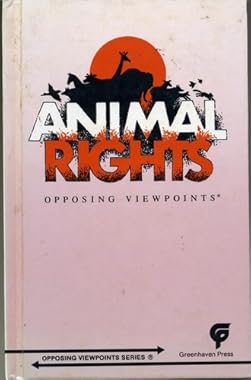
Another book that made a big difference was Animal Rights, opposing viewpoints, edited by Janelle Rohr. This was around the time I'd become eligible to vote. Animal rights was a hot button issue back then, and rather than rely on the consensus of friends and family, I'd decided to do my own investigation by reading what proponents of both sides had to say. 

The book is a collection of essays on everything from abattoirs to zoos. What intrigued me most, oddly enough, wasn't whether the ethical treatment of animals should or shouldn't involve a moratorium on hamburgers or lab rats or whaling or even whether the continuation of any of this stuff is or isn't morally right or humane, though these are certainly important considerations and worthy of debate.

Instead, what intrigued me was Rohr's principle purpose – to arm the reader with the tools essential for critical thinking. She does this by outlining basic rules of logic and summarizing some common fallacies, such as what constitutes a circular argument and how appeals to emotion and to authority, while useful and maybe legitimate, are no substitute for deduction. She then offers two essays, one for and one against, say, fur trapping, after which she asks the reader whether s/he spotted the fallacies. Another pair of essays would follow arguing for and against, say, primate research or hunting. Subsequently the reader is taught how to dissect a given argument, evaluate its merit, and determine whether it warrants the essayist's thesis statement.

I found these exercises exhilarating. It awoke in me a love for logic. Philosophy became my fetish, and I would go on to apply what I'd learned to an array of subjects.

As a Christian, I'd be remiss if I didn't at least mention the Bible as an important influence. Certainly my faith, based on the teachings in the Bible, changed my life. But, to be fair, the good book can't be considered the catalyst for my conversion so much as an ongoing resource, since my transformation began with the apologetics of C. S. Lewis, Peter Kreeft, and, to a lesser extent, Francis Schaeffer. At the risk of seeming impious, I probably owe as much to Mere Christianity, Between Heaven and Hell, and He Is There and He Is Not Silent as I do to the New Testament.

Around this time I developed a fascination for ancient civilizations and got interested in these same ancient peoples' belief systems. This is when I actually read the Bible from flyleaf to flyleaf, as well as The Upanishads. This in turn got me interested in world mythologies, Edith Hamilton's great work Mythology chief among them. And this indirectly bled into a passion for legends of antiquity, folk tales and the like.

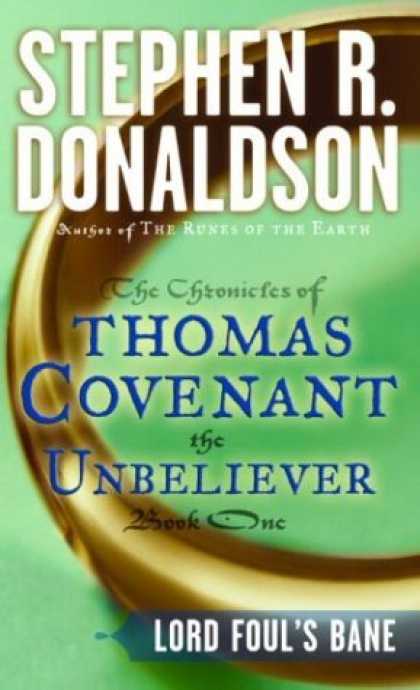
Contemporary fantasy fiction was the next step in my literary journey. That year a friend introduced me to Tolkien's Hobbit and Lord of the Rings, George MacDonald's pair of Princess tales, and C. S. Lewis' Narnia Chronicles. Shortly thereafter, I'd reached the bottom of the book bin, reading mostly poor grade fantasy fiction by some popular but mediocre writers. I asked a well read friend whether he knew of any epics comparable to Tolkien's Rings trilogy he could recommend. The result was Stephen R. Donaldson’s extraordinary novel Lord Foul's Bane from The Chronicles of Thomas Covenant the Unbeliever.

This dark, controversial story altered my ideas about conscience and culpability. The protagonist's deeds and the subsequent complications that ensue impacted me like no other work of fiction before or since.

You can find hundreds of reviews of the novel on amazon here and a stellar examination of the plots, themes, and implications of the entire Chronicles on wikipedia here.

SRD has a unique, intense style. Everything is told in a tone verging on violence. There's a sense of urgency throughout. I've yet to find a novelist who explores the psychological turmoil of his characters with such energy and conviction. His approach exemplifies the intrinsic power of the written word. 

If any book can be said to have changed my life, it's this one. Reading Lord Foul's Bane made me want to write. Artistic expression wasn't new to me; I'd been a musician since my early teens. But only now did I consider words as evocative as music. Over time, my muse sang less and whispered more. Melodies were replaced with story ideas. I've been writing ever since. 

Wednesday, May 8, 2013

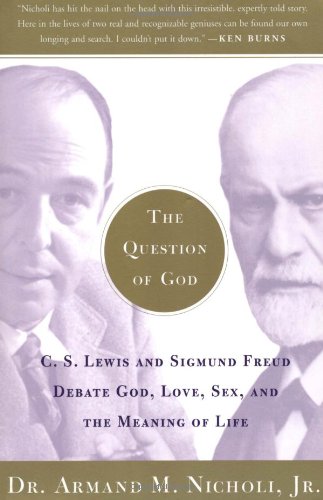
The Question of God; C.S. Lewis and Sigmund Freud Debate God, Love, Sex, and the Meaning of Life, by Dr. Armand M. Nicholi, Jr.

For over half a century, the work of these two pioneers has influenced millions. Yet their ideologies were diametrically opposed. Freud assumed the Judeo-Christian God didn't exist. He based his entire life's work on the premise that the supernatural was at best untenable; until Lewis' conversion, he too held that belief. Then he became a Christian. This changed his worldview. He embraced God's love, meaning, hope, ideas and values Freud, incidentally, regarded as delusional.

The Prologue opens with their funerals – a couple of quotes from attendees, snippets and summaries from their obituaries, and a brief montage of their accomplishments. A tasty appetizer to prime the palate for the entrée to come.

The lives of these two intellectual icons overlapped in both space and time: Freud lived “not far from Oxford” where, and while, Lewis was a young professor, and the two were separated only by a generation; Lewis' body was buried just 24 years after Freud's was cremated. Both wrote passionately and extensively about their philosophies, and the two shared an interest in literature and psychoanalysis. They published several books, including autobiographies.

Nicholi sets out to address two fundamental questions “What should we believe?” and “How should we live?” He examines Freud's and Lewis' childhoods, their relationships with their families, the historical events that impacted their personal and professional lives, and the philosophies they espoused based not only on their published works but on the less public thoughts contained in the journals they kept and the hundreds of letters they wrote to friends and family. More (maybe most) importantly, the writer explores whether these men practiced what they preached, and, subsequently, whether their lives were enriched.

Both Freud and Lewis experienced heart wrenching tragedies and deep sorrows. Nicholi draws from their letters to expose these wounds. Their deaths near the close of the work, though anticipated, came too soon and made me scrunch my face and clumsily wipe my cheeks.

Detractors have expressed displeasure with Nicholi's conclusions. Some insist the pairing of the two men is unfair to Freud, that Nicholi stacks the deck against atheism, that instead Lewis should've been pitted against the likes of Sam Harris or Carl Sagan.

These objections ignore several factors, some I've already mentioned. Maybe most relevant is what Nicholi says in the Prologue:
Wherever Freud raises an argument, Lewis attempts to answer it.
Thirty years before the publication of this book in 2003, Harvard invited Nicholi to teach a course on Freud. He has been teaching the undergraduates there ever since, as well as the Harvard Medical School students for at least a decade. Initially, the course consisted exclusively of Freud's philosophical views, but as Nicholi writes:
Roughly half my students agreed with him, the other half strongly disagreed. When the course evolved into a comparison of Freud and Lewis, it became much more engaging, and the discussions ignited.
We should also remember that Freud gave us “terms such as ego, repression, complex, projection, inhibition, neurosis, psychosis, resistance, sibling rivalry, and Freudian slip.” Lewis was “perhaps the 20th century's most popular proponent of faith based on reason” and inspired a “vast number of ... societies in colleges and universities”.
During World War II his Broadcast talks made his voice second only to Churchill's as the most recognized on the BBC.
It's difficult to downplay “the sheer quantity of personal, biographical, and literary books and articles on Lewis” published since his passing.

Despite Sagan's highly entertaining Cosmos series, his important work in astronomy and astrophysics, as well as his compelling commentary as it pertains to cosmology, his influence doesn't compare. As for Harris' haphazard reasoning and saccharin science, anyone who believes this atheist would stand a chance against the likes of Lewis is engaged in wishful thinking. A brief sampling of online video or audio debates between Harris and a number of theist philosophers and scientists confirms this. Critical thinking is not his forte.

I can't imagine a skeptic coming away from this work still convinced atheism has anything attractive to offer. Freud's philosophy led to fits of depression and repeated thoughts of suicide; Lewis' faith resulted in personal fulfillment so that even at his most desperate and lonesome hour, he discovered not only an alternative to despair but a joy that surpassed his expectation.

A compelling account of two legends, their legacies, and the implication and consequence of their philosophies. Well written and researched (40 pages of notes and bibliography).

Wednesday, May 1, 2013

The Merriam-Webster Dictionary of Quotations (1992)

I have an aversion to driving in the rain. Reduced visibility, lightning, the risk of hydroplaning  these things make me nervous. But years ago, I braved a Texas summer thunderstorm despite these obstacles. I was on a quest for a book of idioms, and being on a quest romanticizes life's challenges, emboldens the adventurer. At least that's what I told myself.

The rain smacked my windshield like pellets. Lightning flared like a heliarc. But I drove on. I finally pulled into the unpaved parking lot of my local library, shut off the engine, and listened to the terrific kettle drum solo on the roof of my Taurus. I wondered whether I should wait for the concert to end before sprinting the sixty yards from my car to the main entrance. Sensing the onset of a migraine, I bolted.

The rain struck my umbrella like a fusillade as I splashed along the sidewalk. Beside me, the heavy traffic eased forward, headlights blazing, creating the appearance of a funeral procession.

If my dash to the doors had caused me to overlook the early afternoon's preternatural gloom, I couldn't miss it now; the 
library's main entrance, a huge multi-pane glass facade, swelled like a reactorIt was as if the sun, having fled the sky, had found refuge within the bowels of the building. Ads, posters, and schedules taped against the inside of the glass facing out were illumined like lampshades, made semi-transparent by the brilliance beyond.

I pushed past the waist-high turnstile and rushed to the reference desk. That's when I noticed I'd already tracked half a dozen figure eights of unpaved parking lot mud across the linoleum. I returned to the commercial entrance mats and pawed them with my sneakers like a bull preparing to charge as thunder slammed the building and sent the fluorescent lights into arrhythmia.

I never found that book of idioms, but I
 did grab four hardbound volumes featuring everything else from epigrams and aphorisms to proverbs, bon mots, and toastsThe quaint quartet was part of a set called Complete Speaker’s and Toastmaster’s Library, and today, all these summers later, I can't help but consider the contrast between those and this more recent read, Merriam-Webster Dictionary of Quotations, which seems so quarrelsome by comparison. 

Looking back on those four volumes, a symbiosis of sentiment seems to have pervaded. It was as if the composers of each entry all shared the same sensei. I remember imagining those authors and orators at some highbrow dinner party, rapping their champagne flutes with their spoons, clearing their throats, and affirming what everyone else in attendance regarded as true, the unique rhythm and timbre of their voices being the only real disparity. I'm sure the distance of time, from this moment to those many summers ago, morphs mobs into choirs, but I elect to cherish this fond fiction, if it is indeed a fiction, until some snooping statistician proves me wrong.

In contrast, wordsmiths from Merriam-Webster Dictionary of Quotations are more likely to incite a food fight. Regarding Beauty...
What is beautiful is good, and who is good will soon also be beautiful.” - Sappho
It is amazing how complete is the delusion that beauty is goodness.” - Leo Tolstoy

Body and Face...
How idiotic civilization is! Why be given a body if you have to keep it shut up in a case like a rare, rare fiddle?” - Katherine Mansfield
If anything is sacred the human body is sacred.” - Walt Whitman

Optimism and Pessimism...
The optimist claims that we live in the best of all possible worlds; and the pessimist fears this is true.” – James Branch Cabell
I came to the conclusion that the optimist thought everything good except the pessimist, and that the pessimist thought everything bad, except himself.” – G.K. Chesterton

I've got only two complaints. While I oppose the ad hominem, I take exception to known subverters and tyrants. I'll abide Timothy Leary, Machiavelli, Nietzsche, even Carl Marx, but why quote Fidel Castro, Stalin, or Mao Tse-Tung? Incidentally, those last two villains, though featured in the book, aren't listed in the Index. Conversely, the humorist Fran Lebowitz, while indexed, isn't featured in the book. 

Here a better writer would insert a pithy remark about how recording the deeds and declarations of moppets and mass murderers is perfectly acceptable for biographies, encyclopedias, and history books but shouldn't appear in a tome whose subtitle reads 4,000 thought-provoking quotations from the world's most celebrated men and women. Personally, I'd prefer they be consigned to a grimoire entitled The Infamous Drivel of Communists and FascistsRegrettably, despite my inordinate exposure, I'm incapable of crafting such a pithy remark.

How Learning a New Language Improves One’s Life, and other Trivia

Some things are inexplicable. For example, my desire to teach myself a second language at age fifty-two. And what, pray tell, was that secon...