Thursday, March 31, 2016

Bulfinch's Mythology, by Thomas Bulfinch (1959)

Before I review this wondrous work, I should tell you what qualifies, to my mind, as a great book. First and last is the writer's command of the language. I relish books whose authors, above all, know how to string words together in such a way as to create a kind of music, whose prose, because they're so well crafted, I have to resist rereading aloud. I realize that's a stringent demand. Keep in mind, that's my ideal, not my minimum requirement. 

Still, I'm unreasonable in this area, since, let's face it, most writers can't be as good at their craft as, say, Robertson Davies, Nabokov, Colleen McCullough, Steinbeck, J.D. Salinger, Mary Stewart, Dickens, Kipling, Conrad, Jane Austen, or Graham Greene, and, true, I shouldn't hold all writers to such standards. I concede that point. Nevertheless, I'll give a superbly written book up to four out of five stars, regardless plot, characters, or, in the case of non-fiction, subject matter. For example, I'm currently reading a book called The Beautiful People. It's about the history of fashion design, a subject I'd care nothing about if it weren't for the terrific prose by the book's author Marylin Bender.

The second thing I look for with regards to fiction is characters. They must be unforgettable, believable, and interesting, characters like Atticus Finch (To Kill a Mockingbird), Holden Caulfield (The Catcher in the Rye), Sherlock Holmes, Thomas Covenant, Ignatius J. Rielly (A Confederacy of Dunces), Ichabod Crane (The Legend of Sleepy Hollow), and Tom Sawyer.

And last, though almost equally important, is the educational aspect of a work. By that I mean all sorts of things from learning a host of new words or terms to general information I didn't know about a particular region or period in history. If, say, a character has a profession the writer explores, or if the story takes place in a country foreign to my experience so that I learn something about its societal mores or customs, its imports and exports, I'm pleased. Time well spent. Words and or references I have to look up, techniques that intrigue me, and so on, prejudice me in favor of the book and the author. Exposed to new things, I learn, thereby increasing my vocabulary and my knowledge base.

I don't mean to suggest that I can't enjoy what Jeeves would describe as “light, attractive reading.” After all, ultimately I read for pleasure. I enjoy mystery, romance, and humor as well as the next casual or general reader. Much like an insipid pop song or a fattening pastry, transient diversions, provided they're enjoyed in moderation, have their place. And despite being what many might regard as a literary snob, I can relax and plunge into a forgettable tale for the mere sake of escapism as easily as any other literary pleasure seeker. So yes, I'll read most anything, even if the author isn't concerned with enlightening or challenging me. But such books don't especially excite me. They certainly aren't the sorts of books I'd recommend.

That said, if a writer can meet all three of the above criteria – exceptional prose, interesting characters (real or imagined), and insightful, informative content – a glorious combination ensues I can't resist blogging about.

Thomas Bulfinch (1796–1867) achieves all three of these things in his celebrated publication Bulfinch's Mythology. The book actually combines three volumes – The Age of Fable (1855), which covers the Greek, Roman, and Norse myths; The Age of Chivalry (1858), which deals principally with King Arthur and his noble knights; and The Legends of Charlemagne (1863), my least favorite and the shortest of the three.

I'm not overstating the relevance, importance, or influence of this material when I say the stories herein comprise the bedrock of Western Civilization. Our culture owes a great debt to these tales of antiquity. From classifications in botany and medicine, astrology and astronomy, the arts – statues, paintings, literature, film – the stories of ancient gods and heroes have impacted generations for centuries. 

Sure, Virgil, Ovid, Homer, Milton, Shakespeare, Byron, Euripides, et al, all of whom either wrote extensively about, or referenced liberally from, these archetypes and their adventures, are indispensable to our classic library of masterpieces. But that's not even the half of it. Consider the staggering array of references and derivations, apart from the constellations, we take for granted. Themes (Justice) held “aloft a pair of scales” hence monuments to Lady Justice on the steps of some of our courts and university campuses. Mercury (Hermes) who carried the “rod entwined with two serpents,” called the caduseus, is to this day the insignia for the medical profession.

Words in our modern English language such as Odin (spelled Woden) gave us the word Wednesday. Thursday is derived from Thor. Halcyon from Halcyone, as well as the flower hyacinthus. Mentor; Somnambulism and somnolent from Somnus (the personification of sleep); morphine from Morpheus; the story of Echo and thence our use of the same word in the same context, arachnid from the story of Arachne; Narcissus; Melancholy; Meander; Cornucopia

The prefix for panic is derived from Pan. The expressions “Bellerophnic letters” and “Penelope's web” are likewise derived from ancient myths. An an aside, Sting, in the 1980s pop rock group The Police, refers in the song Wrapped Around Your Finger to “Scylla and Charybdis.”

If I ever get a pet, it'll be a dog, and I shall name him Argus. When Ulysses returns from his Odyssey, which, remember, is the voyage he embarks upon after his long years at war near the walls of Troy, his faithful dog, now an octogenarian in dog years, who's been awaiting his return, can at last expire.

... soon as he perceived
Long-lost Ulysses nigh, down fell his ears
Clapped close, and with his tail glad sign he gave
Of gradulation, impotent to rise,
And to approach his master as of old.
Ulysses, noting him, wiped off a tear
Unmarked.
Then his destiny released
Old Argus, soon as he had lived to see
Ulysses in the twentieth year restored.” (pp. 203 – 204)

Many of the geographical place names of that epoch are still in use today: the Ionian Sea named after Io; Athens named after Athena, Media therefrom Media in Asia, Hellespont (now the Dardanelles) named after Helle; Cape Palinurus from the character Palinurus. The river Acis from the story of Galatea and Acis. And let us not forget the Olympic games (or the Olympics) derived from the word Olympus, the fabled abode of the Greek gods.

Some of the heroes – Theseus, Jason, Hercules – are semi historical. One story in particular offers the reader a glimpse into the rich metaphors often used by the ancients to relate facts or truths in spectacular ways. Achelous, the river god, recounts the wrestling match he and Hercules engaged in together for the love of a fair maiden named Dejanira. Achelous took on the shape of a great serpent and then, when that proved vain against Hercules, assumed the form of a bull. But he was still no match for Hercules who threw Achelous to the ground and broke off one of his horns. “The Naiads took it,” Achelous recounts, “consecrated it, and filled it with fragrant flowers. Plenty adopted my horn and made it her own, and called it cornucopia.”

The ancients point out elsewhere that “Achelous was a river that in seasons of rain overflowed its banks. When the fable says Achelous loved Dejanira, and sought a union with her, the meaning is that the river in its windings flowed through part of Dejanira's kingdom.” Considered to have taken the form of a snake due to these windings and to a bull because, during its course, it roared and brawled, Achelous, when overflowed, was thwarted when Hercules labored to impose canals and embankments, thereby cutting off its horn. No longer subject to overflow, the lands became fertile, hence the horn of plenty. (pp. 144 – 146)

I can't help but wonder, of all the stories of the Old Testament – Jonah and the fish, Samson and Delilah, Noah and the Ark, The Tower of Babel – how many of them follow a similar vein. Even if such stories aren't factually accurate, I suspect they harbor metaphorical truths our modern minds, preoccupied with the literal, often lack the ability to discern. Whatever the answer, those same stories undoubtedly deal in poetic truths no less meaningful than the modern facts science insists on, poetic truths about human frailty, courage, despair, humility, and faith, among other virtues and vices.

And that's only the first part of this three part masterpiece known as Bulfinch's Mythology. Part two, The Age of Chivalry, covers the romances of King Arthur, his noble knights – Sirs Gawain, Launcelot, Tristram, Perseval, Galahad, Bohort – the Lady of the Lake, and of course Guenever and Merlin. Also included is a captivating summary of Malory's Le Morte d'Author.

Bulfinch's writing style is superb. The stories, though more exhaustive than Edith Hamilton's work Mythology, which I enjoyed, are still all too brief. Despite their brevity, however, they're precious marvels. Betimes harrowing, often mystical, and always captivating. Yes, I'm giving this book five out of five stars. But to adequately stress this book's importance, I'll go one step further, though with the tip of my tongue against my inner cheek. Five out of five stars here means if you don't read this book, you're dead to me.

Sunday, March 20, 2016

My Love Affair with Books

I wasn't always an avid reader. As a child and a young teen, the only time I cracked open a book was when my brother and I misbehaved, since, as punishment, our mother would force us to memorize specific chapters from the book of Psalms. Books in our home were shelf decor, neither springboards for the imagination nor educational resources. My scant reading meant poor reading skills which in turn meant scant reading. This vicious cycle kept me away from books and in front of the cathode ray.

School was no different. Because I abhorred the public school environment, I resisted instruction. And not applying myself meant consequently learning next to nothing. It wasn't until after high school that I realized it wasn't knowledge I despised but the imposed regimen, a regimen that determined precisely when and what to memorize.

This attitude changed when I turned eighteen. Eligible to vote and registered for selective service, I took inventory of my ignorance under the tutelage of the public school system and discovered I was, intellectually speaking, an idiot.

Meanwhile, I'd listened to the vague declarations of friends and family on the political and religious hot button issues of the day – animal rights, abortion, euthanasia, capital punishment, God. While intrigued, I remained clueless about how to make sense of it all. I wasn't about to oblige popular opinion for the sake of acceptance or validation any more than I'd take an opposing stance merely to appear independent.

Instead, I wanted to know on what basis one position was more reasonable or legitimate than another. Unfortunately, neither friends, family, nor the clergy were much help. Despite their convictions, these people appeared to have never explored these issues beyond casual conversations among those with whom they already agreed. 

Though I couldn't have articulated my dilemma at the time, I sought an assurance beyond the flippant proclamations and bumper sticker slogans of my peers and elders, a method or a criterion with which to gauge the merits of a claim to determine which position offered the most rational thesis. 

Then, either nineteen or twenty, at a mutual friend's birthday party, I met a man nearly a decade my senior who, over the course of a pointed interaction, demonstrated such an exacting, sober, insightful method for making sense of things that I was both encouraged and thrilled.

We shared some common interests and were soon meeting for lunch. In no time I discovered I had little more to offer than my rugged good looks, overly inquisitive nature, and self contradictions. He, instead of dismissing me for the fool I was and recommending I go play in traffic, listened to my conundrum. Once he'd casually dissected what at first blush appeared complicated until it rendered up its secrets, I had to know his method. But, God bless him, rather than telling me what ideology to adopt, he pointed me to the writing material that addressed my questions – newspaper columns, magazine articles, and essays on a host of political and philosophical issues we'd discussed, both for and against a given subject. I was curious enough to bite, and it’s with a proud heart, a moist cheek, and a bruised ego that I confess his passive prompting led me to embark on a life-altering journey for which I remain eternally grateful.

What began as modest curiosity blossomed into an insatiable inquisitiveness. I found myself engaged in a fierce race toward that elusive prize known as illumination. I still recall, in my twenties, moistening my pupils with Visine to combat my sore, dry eyes, and popping Bayer or Bufferin tablets as though they were Flintstones Chewables to minimize the headaches, all the while sitting up in bed under the buttery glow of lamplight reading until dawn.

I’d become the solitary bibliophile, having embarked on an ambitious journey I’d privately dubbed Making Up For Lost Time. Soon my self-imposed reading marathons became what might best be described as an epistemological pilgrimage. In a year, I'd assumed the title autodidact, an amateur scholar whose only stipend was the occasional pearl of wisdom gleaned from the printed word. Consequently, I'd graduated from articles and essays to books on general, religious, political, and moral philosophy as if my soul depended on it.

In this way I learned first hand what can never be communicated to the passive reader, namely that the written word is the only medium offering the best opportunity for providing a measured, exhaustive examination of anything, the only encompassing process for engaging one's imagination, encouraging one's thoughts, and fully evoking one's emotions.

Within roughly six years, not only had I more than compensated for my previous academic career of indifference in the public school system, I’d discovered an exciting literary world that reduced all other forms of entertainment to table scraps. For me, the public libraries and bookstores had become the consummation of humanity’s crowning achievements – enshrining our noblest thoughts, our deepest insights, and our most enduring creations.

Yet like any adventurer embarked on an expedition of discovery, I often felt alone, sometimes with little more than guilt to spur me onward, guilt over my earlier years of academic neglect. 

Over time this immersion into literature fostered an ugly contempt for my contemporaries. I confess I grew alienated from most of my friends and family. They were preoccupied with pop culture. I wasn't. As adults, they spent as much time watching TV as I had as a teen. I gradually grew to detest television and treated friends and family, depending on my mood, with either pity or scorn. 

Don’t get me wrong. It wasn’t as if I pined for a metropolis where everyone took a sledgehammer to their flat screens, visited museums, and liberally quoted Oscar Wilde. Unlike the vegetarian who decides her friends are going to Hell for eating animals, I didn't consider my coevals damned, but I knew they were not only missing out on one of life's greatest pursuits and pleasures, they were depriving themselves of what really mattered – knowledge, insight, clarity of thought. 

This heartache tainted my joy when I considered the suspicion my passion for reading provoked in others. Unless I was willing to endure a summary of their diet or what happened during the most recent season of their favorite TV show, material for conversation became increasingly limited. And those who viewed my pursuits with indifference, who showed no interest for my passion, caused me to only recede further into my solitude and study. But I couldn't abandon my passion for books any more than a lover can deny love. Because, truly, at this point, my love for language, for clear expression, knew no equal.

The relationship between writer and reader, the gratification that comes from glimpsing, and, dare I say, occasionally comprehending, an idea or a truth, remains my dharma. Fellow avid readers know. Even in a crowded coffeehouse, we read (for all practical purposes) alone. And though music and other ambient sounds might attend our immersion, in this self-imposed cell of solitary confinement, our minds and thoughts are focused. 

What we grasp as a result can seldom be communicated. In turn, we learn how far superior this medium is to all other forms for conveying unforgettable stories and any ideology worth thinking or talking about. To weigh and explore the innermost thoughts and feelings of some of the brightest minds articulating their imagination and purpose in print knows no equal. 

Today my fidelity to books has given me a greater appreciation for the things these books reveal, and this has made meaningful to me ideas as well as virtues I might never have otherwise considered significant or relevant.

Someone once wrote that books are the only things you can buy that make you richer. Books, for me at least, are the most treasured of inanimate objects. What words convey and stir in the hearts of readers confirms their power and their impact. I'll always regard them, or more specifically their authors, as the best storytellers, priests, sages, and guides. They continue to provide insight and pleasure I'll forever cherish.

Tuesday, December 1, 2015

The Song of Bernadette, by Franz Werfel, translated by Lewis Lewisohn (1941).

Even if you're not religious, this story is sure to evoke a smorgasbord of emotions. The accounts of poverty and politics during this period (circa 1850) are rich in detail and absorbing. The cast of characters are touching and real. This is more than a good yarn. This is beyond subtle commentary on faith and doubt and human nature. The telling is packed with great, sometimes heart-wrenching, scenes. Understandably, this classic maintained the New York Times Best Seller list for 13 weeks.

As a nod to the Catholic Rosary, the novel is comprised of five parts, each part containing ten chapters. To my surprise, part one takes on present tense. I'm not sure whether this qualifies as unique for novels written seventy-five years ago, but it might.

What intrigued me most was Bernadette's simplicity. Since fiction writers are forever instructed to make their protagonists interesting, whether by introducing a glaring flaw or a striking quirk (such as my youngest sister shaking a branch of sage around the house to ward off evil; I love her dearly for it), the protagonist must stand out, be memorable. Ironically, Bernadette is a rather plain and plain spoken twelve year old. She suffers asthma and receives her share of bullying. Beyond that, she isn't particularly remarkable. However, throughout the course of the story, you find yourself caring deeply for this poor and poorly maligned girl. In the process, it's her simplicity and ignorance that becomes her charm.

The story behind this novel is likewise engaging. While Franz Werfel and his wife fled from the Nazis through France in 1940, the author learned about Bernadette, the preteen on which the novel is based, who purported to have experienced a total of eighteen visions of the Blessed Virgin Mary in Lourdes in 1858. She was eventually canonized in 1933. Moved by the accounts and interviews he subsequently conducted, the writer vowed to write the protagonist's story once he reached the United States. I'm glad he did.

Overall, a well written story with lots of emotional impact. Five out of five stars. 

Friday, September 25, 2015

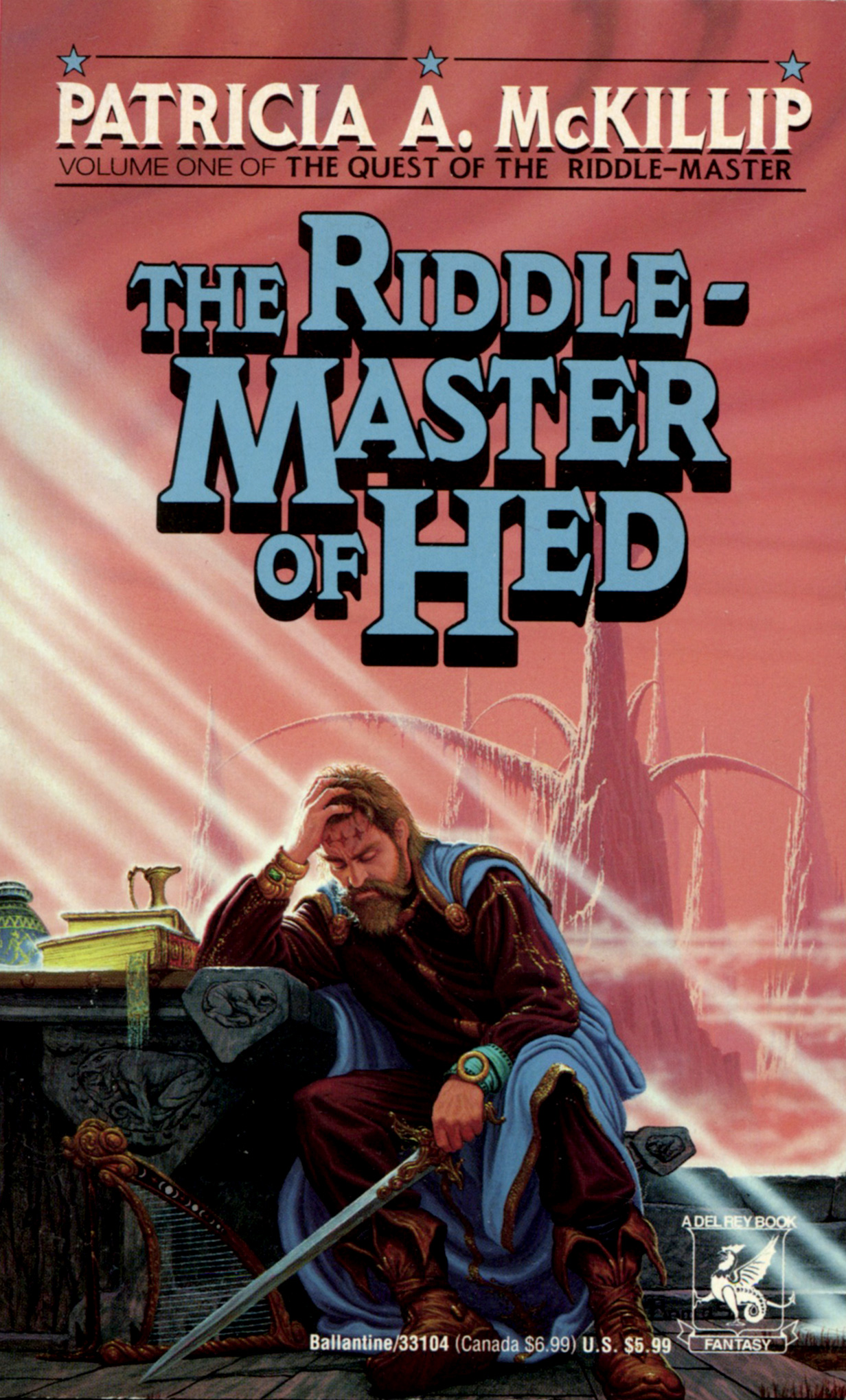
The Riddle-Master of Hed, by Patricia A. McKillip (1976)

When a friend recommends a novel, my first question is never, What's it about? Instead, I always ask who wrote it. If not familiar with the author, and if I know my friend has discriminating tastes, I ask, What's the writing like? I once loaned my copy of Tolkien's The Children of Húrin to a friend with the qualifier, The subject matter is pretty morbid. This triggered a raised brow. “But, I said, the writing is superb. To which he replied, Well, it's Tolkien! 

Whether you revel in stories involving space aliens, 19th century sleuths, druids of antiquity, lovers in the Victorian Era, modern day cyber criminals, fairies with an inexhaustible supply of pixie dust, or talking animals, no qualifier exists to gauge the value or validity of such interests. To each his (or her) own, I say.  

The rules of grammar, on the other hand, while not the ultimate factor for determining a thumbs up or down of any given work, is a good first step toward gauging quality of prose and clarity of thought. In fact, the whole point of these rules, though admittedly malleable, is to encourage comprehension. When it comes to novels, this criterion is one of many among a host of objective standards for evaluating, dare I say, the discipline known as fine writing. 

Because suspension of disbelief is individual and each reader's threshold is different, my focus isn't so much about what happens in a story but rather how it's conveyed. As a great writer and friend has said, “It's not about what you write, but how you say it. If you get the words right, it's like music on a page.” 

So to be clear, this critique is concerned with the writer's execution, delivery, style, and command of the language, not subject matter. This is my only stipulation. Well, that and an engaging story. I don't think that's too much to ask.

This is why, despite my aversion to much of the perversity and despairing content in any number of Nabokov's novels, I tend to give his stuff five out of five stars. For the same reason, regardless my love for fantasy fiction, I'm giving The Riddle-Master of Hed a negative nine. Essentially, this is because Nabokov is a master wordsmith, whereas McKillip can't compose a coherent sentence.

As I mentioned in a previous post, I recently came across an online list from BuzzFeed: “The 51 Best Fantasy Series Ever Written.” So, after a long hiatus, I decided to return to the genre in the hopes of reading some of the more, presumably, better novels of that genre. 

So far, I'm regretting that decision. In fact, if I've learned anything from this most recent novel, apart from what not to do as a writer, it's that Del Ray has some fairly low standards. Based on this entry and a few others on the list I've read, most modern writers of this genre, subject matter aside, are at best subpar and at worst in need of a composition 101 refresher course. 

First, the title of this novel is beyond misleading; it's false advertising. The protagonist Morgon is hailed as a riddle-master. Morgon is said to have battled another riddle-master and won a king's crown before the story begins. (We readers are deprived of this scene.) Yet despite the “riddles” presented to Morgon throughout the novel, as well as the “riddles” referred to in his game of wits with the other riddle-master off-stage, none of these “riddles” are actual riddles. 

Indeed, someone needs to explain to the author that while a riddle is a sort of question, a question is not a riddle. Like other word problems, riddles frequently contain clues; questions generally don't. Granted, some riddles offer no clues but rather require one's powers of deduction, and some riddles are deliberately misleading. Still, there's a considerable difference between “What three letters transform a boy into a man?” (Age) and “What's the capital of Kansas?” (Topeka). Here are some other legitimate riddles: “How many months contain 28 days?” (All 12 of them.) “A woman has seven children. Half of them are boys. How is this possible?” (They're all boys.) “I have a head. I have a tail. But I have no body. What am I?” (A coin.) Or, to be precise, a talking coin.

In this novel, not a single clever query or rhyme is offered. Instead, we get questions like, Who is the man in the red robe? Neither the protagonist nor the reader knows. We've never seen such a man, and when the question is asked, no man is about, red-robed or otherwise. 

Leaving aside the plot, let's further ignore the fact that the protagonist in this novel has three inexplicable stars on his forehead. (I say inexplicable because the author never explains these markings in the story.) Nor will we examine the alleged appeal of a protagonist taught to become a shape shifter, a vesta, whatever that is (the author doesn't specify, nor is a vesta listed in the glossary at the back of the book, though from what I gather it's a kind of elk or deer). Nor the fact that another character teaches the protagonist how to temporarily become a tree. Whether these sorts of things appeal to readers I leave to the readers since, as I say, personal taste, and hence subject matter, is subjective.

Having said that, this is by far the worst novel I've ever read. I offer some examples. Keep in mind McKillip, the author, has an MA in English, and this novel ranked 13th in a 1987 reader's poll for All-Time Best Fantasy Novels and 22nd in their 1998 poll. Nevertheless McKillip tends to compose the most clumsy sentences this side of the Mississippi. Not a single paragraph shines, and some of her awkward construction is downright horrid.
Heureu had risen. He gripped Morgon firmly; his voice sounded distant, then returned, full. “I should have thought …”

His voice returned full? From what? From its distance? Does it matter whether Heureu's voice is full or sounds distant or returns? 
The harpist rose. His face was hollowed, faintly lined with weariness; his voice, calm as always, held no trace of it. “How do you feel?”

Held no trace of what? Of weariness? Why write this way? How about this: The harpist rose. He looked weary. Calmly, he asked, “How do you feel?”
He smiled reminiscently.

How exactly does one smile “reminiscently”?
Morgon drew a breath. His head bowed suddenly, his face hidden from the harpist. He was silent for a long time while Deth waited, stirring the fire now and then, the sparks shooting upwards like stars. He lifted his head finally.

Point of view violations aside, the author writes reams of confusing narrative like this. Characters constantly look one another in the eye, look away, look down, turn, lift or lower their heads, etc. Meanwhile, antecedents get shuffled and the reader is left to guess about who's speaking and doing what. I'm still not clear which one of them, Deth or Morgon, was stirring the fire "now and then" nor who to ascribe the pronoun to in the last sentence. And since when do sparks from a fire remind one of stars? 
Morgon drew an outraged breath.

What precisely is an outraged breath? Morgon was outraged? Got it. He sighed in exasperation? Maybe. How about telling us simply, “Morgon was outraged” or “Morgon was exasperated”?
The next morning, he saw Herun, a small land ringed with mountains, fill like a bowl with dawn.

Do bowls ordinarily fill with dawn? Essentially this allusion is aided by the appearance of mountains which “ringed” the “small land”. Fair enough. But the phrase “a small land ringed with mountains” is problematic, given Morgon's decision beforehand to avoid crossing or traveling through mountains of any kind. In other words, how did Morgon reach a small land ringed with mountains without first traveling through said mountains which the author told us earlier he'd already decided to avoid?
He closed his eyes, smelled, unexpectedly, the autumn rains falling over three-quarters of Hed.

Hed is a region. How does the protagonist know the extent of its rainfall? Imagine standing on a stretch of farm land while it's raining. Could you determine whether only half the farm was receiving rain? Or two-thirds? Or “three-quarters”? Plus, even if Morgon possessed some inexplicable preternatural sight for perceiving rainfall ratio to acreage, we're told at the beginning of the sentence that he closed his eyes.

I leave it to the reader to consider the structure of the following sentences, their relevance, and the quality of the similes:
Gently as small birds landing on his mind came questions he no longer had to answer.
The fire sank low, like a beast curling to sleep.
Morgon, his eyes on the fire, felt his mind fill with faces …
He was almost unable to breathe.
He stirred, his face turning to Har's. Their eyes met [for] a moment in an unspoken knowledge of one another.
He paused, looking again at Har; his hands moved a little, helplessly, as though groping for a word.

I'm reminded of Jean Eggenschwiler's observation in his fantastic book Writing: Grammar, Usage, and Style, “Most can distinguish between solid content and inflated trivia.”
Danan drew a breath to speak, but said nothing.
He leaned forward, his face etched with fire, and roused the half-log on the hearth. A flurry of sparks burned in the air like fiery snow.

So flames from the hearth don't illuminate his face; they etch it with fire? And what is a half-log anyway? Isn't this comparable to half a hole? Isn't a hole, regardless its size, still a hole? And since when do sparks from a fire burn like snow, fiery or otherwise?
the wizards themselves, skilled, restless and arbitrary, would never had [sic] dreamed of trying to kill a land-ruler.

If the wizards are “arbitrary,” what's to prevent them from dreaming such a thing, or anything for that matter?
Morgon felt eyes on his face.

I assume this is comparable to feeling that you're being watched, but not only is this a poor choice of words, it's an utterly frivolous point to make, considering the fact that Morgon is eating in a public place. It stands to reason diners would steal occasional glances at fellow diners.

Nathaniel Hawthorne said, “Easy reading is damn hard writing.” I suspect a lot of fantasy fiction writers aren't particularly concerned about the quality of their writing. And why should they be? Some publishers clearly aren't concerned about their writing quality either. As a result, this genre gets a bad rep for pumping out the equivalent of glorified comic books. I can't speak for an audience so easily sated. Such low standards keep certain writers and publishers in business. I, on the other hand, remain disappointed. 

Monday, August 31, 2015

The Slow Regard of Silent Things, by Patrick Rothfuss (2014)


Before commenting on this book, I need to give you some background. Just eleven days ago, BuzzFeed Books online posted “The 51 Best Fantasy Series Ever Written.” It listed Rothfuss at the top with his novel The Name of the Wind. Yesterday I drove to my local library, but that novel was checked out. So I grabbed his book The Slow Regard of Silent Things instead. I read it the same day. It's a short book.

Now we've all run across these sorts of online lists before. Last year I found the site “BestFantasyBooks.com, which boasts several lists: 100 Best Fantasy Novels, 100 Worst Fantasy Novels, Best Fantasy for Women, Best Fantasy for Children, Fantasy with Dragons, etc. And after recognizing some of the entries, some of which I'd read and considered crap, coupled with the fact that the site is maintained by a book critic whose writing – spelling errors and bad grammar galore – failed to inspire confidence in his skills in discernment, I ultimately dismissed that site as a waste of time.

Which might seem odd considering that back in my early twenties, when I wasn't the curmudgeon I am today, fantasy fiction was my favorite genre. I preferred stories about knights and elves and dragons much like a widow or a single mom might gravitate toward romance novels or erotica. But I was a child with regards to literature back then, having yet to experience Bradbury or Davies or Nabokov or Salinger or Steinbeck. In other words, I'd essentially lived on drive-thru fare and had never been to a four star restaurant. What did I know about fine dining? I was too busy championing the convenience of bland burgers sealed in Styrofoam.

In fact, by the time I'd reached the bottom of the book barrel of fantasy fiction in my mid-twenties, having already read Tolkien's Rings Trilogy, Lewis' Narnia Chronicles, and George McDonald's Princess duology, I moved on to the transient trash of some of the more contemporary fantasy writers. (I won't name names.) It was round this time that, in a moment of desperation, I accepted a boxed trilogy from a friend. A Dragonlance series by the writing couple Tracy Hickman and Margaret Wies. It shames me to recall that I actually recommended the first book to another friend who has since published nearly a dozen novels. This friend has read hundreds and hundreds of books.

Needless to say, he knew the difference between quality and crap. And I'll never forget what he said when I asked him what he thought of Dragons of Autumn Twilight, book one of that trilogy. His critique made me reconsider the quality of the junk food I'd been scarfing down my pie hole. I'm paraphrasing. “Pretty shallow. For one, the characters are flat. A bunch of stuff happens but nothing of real consequence to the story. There's no depth, no substance. Sheer escapism, really. Not my thang.”

Once I'd recovered from this bombshell I asked him whether he knew of any fantasy fiction that offered the kinds of things he was talking about. He recommended Stephen R. Donaldson's Covenant Chronicles. Anyone who knows me knows about my love affair with Donaldson's genius. Those books fried my brain. I soon realized not only what was possible but what awful rot I'd been reading. It was because of Donaldson that I became a writer.

The point is I'm no longer the indiscriminate fantasy fiction fan. In fact, I hesitate to mention this, but I've become that literary snob you were taught to avoid. I don't want to be cast out of the reading circles for my heresy before I'm ever invited, but I can't lie and pretend I fell in step with the Rowlings' fan base and her Harry Potter stuff. I read the first three books stoned, and it still didn't help. After reading masterpieces like Ivanhoe, Ben-Hur, The Iliad, the Odyssey, and Don Quixote, it's hard to find pleasure in R.A. Salvatore or Richard Monoco. (Okay, so I'm naming names after all.)

Before you dismiss my criticism as the ravings of a prude, I'd love to crack open any novel by, say, Graham Greene or Kipling or Mary Stewart and compare it to your favorite passages in, say, Terry Brook's Sword of Shannara. Then you can tell me whether Brooks' prose, in contrast, doesn't stink to high Heaven. After spending a few minutes examining some of the greats, I believe that you, too, will begin to recognize the difference between inspired storytelling and meandering muddle.

While I can't bemoan the realities of an indiscriminate fan base that devours mediocrity without question, I don't have to buy into the hype. There's a story about a certain publisher of fantasy fiction who was asked by a colleague about her decision to publish a certain work many regarded as a piece of shit. Her response was, “Look, most of our readers are children. They've read The Lord of the Rings 50 times. They want something new. They don't have discriminating tastes.”

I can't tell you how many times I've read reviews on Amazon.com in which the reader says, “Two out of five stars, but I'll probably read the rest in the series.” I can't help but wonder why, when there's so much wonderful literature out there, unless of course said reader is partial only with regards to genre.

Having said that, and to show what a hypocrite I am, I still plan to read the books listed on BuzzFeed's site, the ones I haven't read already, even though most of the few I've read on that list were of poor quality. One of the reasons I've decided to do this is because I write fantasy, and I think it's important to know the market. Not to be cruel, but one can learn from bad writers too, if only to confront what not to do. I've said this before: no serious writer has any legitimate excuse for pushing a bad manuscript anymore, to say nothing of some of these publishing houses that ship out this drivel. With access to writer's workshops and books that teach the mechanics of storytelling, character and plot development, as well as friends willing to read one's stuff and tell him or her whether what they've written is crap, we the reading public should be spared the inglorious experience of second rate novels.

With that in mind, I refer you to something Rothfuss said in the Author's Forward of his book The Slow Regard of Silent Things. “You might not want to buy this book.” Gratefully, I got my copy for free at the public library. “First, if you haven't read my other books, you don't want to start here.” Fair enough. I appreciate the heads-up. A few paragraphs later, he writes, “Second, even if you have read my other books, I think it's only fair to warn you that this is a bit of a strange story.” Had I known Rothfuss' definition of 'story' was 'a series of scenes lacking any character apart from the protagonist with no dialogue and no plot and no gradual building toward an ending let alone a climax,” I certainly would've dropped the book in favor of anything else from my stack of Books-To-Read-This-Year.

At the same time, and to be fair, I've read, and have enjoyed, plot-free novels. Though my friends enjoyed Ray Bradbury's Dandelion Wine more than I did, that's one example. Steinbeck's Travels with Charlie, which I thoroughly enjoyed, is another. And in Rothfuss's defense, I should point out the guy's not an awful prose writer. In fact, I'd go so far as to say his style, though rough round the edges, has a certain charm. Like Nabokov, he evidently enjoys word games and playing with homonyms. But Nabokov's word games never distracted from the flow of the writing. With Rothfuss, it's beyond distracting; it's downright confusing at times. I'm grateful this vignette is only 150 pages or so since I couldn't have gotten through a novel length version of what amounts to a meandering rough draft.

Lastly, at the back of the book, at the Author's Endnote, Rothfuss writes about this book: “It was weird and wrong and tangled and missing so many things that a story is supposed to need.” Having read the thing, I'd agree. He goes on to say that he'd never intended to write this 'story' and that he'd argued against the merits of this 'story' with a friend who claimed to like it. He goes on to talk about his writing in general, how “The Name of the Wind does a lot of things it's not supposed to do. The prologue is a laundry list of things you should never do as a writer.” He then justifies this approach by arguing that “Sometimes a story works because it's different.” Different and doing “... a lot of things it's not supposed to do” are two entirely different things. Look, I can empathize. I've written stuff I'll never show to anyone. But that's the difference. While I celebrate those hypnotic writing sessions when the Muse is whispering in your ear and you're typing furiously to keep up if only to discover what will happen next, there's a difference between this practice and the final performance or end product. Just ask any recitalist. Don't fall prey to what one critic has distinguished by saying “That's not writing; that's just typing.” If you publish your ramblings, expect to be chided.

As any good writer will tell you, part of the manuscript writing process involves dumping sometimes tens of thousands of words. Of my 150K word manuscript, I tossed at least that much, and yes, I would've preferred some anesthesia during some of that surgery. False starts, weak scenes, bad lines, and so on must be expunged from your finished work. Unless they're like me and frequent the public library, readers pay good money for books and deserve better.

Again, Rothfuss shows promise, and I think he could achieve great things. I was encouraged to read that he has dozens of beta readers. I wish I could lay claim to dozens. I just wish his beta readers had more discriminating tastes or demanded the sorts of things good stories require, such as a plot, character development, and scenes that effect the story's outcome. But I'm not about to outline what any number of good books on the subject could teach him.


Monday, July 14, 2014

Confessions of a Literary Snob in Recovery

Prior to my exposure to crime fiction novels or (if you prefer) suspense, thrillers, murder mysteries, burglar books (I love alliteration), my choice of reading material might've conformed to what Jeeves referred to as 'improving books'. Independent of the college curriculum, I gravitated toward the staples of higher learning. My literary nourishment focused on the published ideas of the great philosophers, the verse of the famous poets, and the prose of the classic novelists. If I wasn't scrambling to read everything from Socrates to Sartre, I was immersed in the epic tales of Homer, the tragedies and sonnets of Shakespeare, even sprinklings of William Blake and James Joyce when no one was looking. And if those masters weren't keeping me up nights, it was the 19th to early 20th century fiction (and diction) of Dickens, Stevenson, Wells, and Twain.

Of course even the most prudish palate occasionally indulges in a hot dog and a bag of chips. I read a number of Doyle's Sherlock Holmes short stories in my 20s, a random Agatha Christie novel (Ten Little Indians) in my 30s, and, don't ask when (my notes don't say), Dashiell Hammett's Maltese Falcon in a dayI recognize this is nothing compared to the murder mystery aficionados who were still teething when they read The Hardy Boys and Nancy Drew. But when you begin your reading career with Kafka's rich metaphors, Tennyson's lofty verse, and Nabokov's linguistic flourishes, a good deal of murder mystery, in contrast, reads like glorified telegrams.

What's more, and I suppose it's the outlier in me, when I think of Mystery, my mind doesn't swing toward the boot print on the herringbone parquet or the hair fiber on the escritoire. Instead, I think of the wonders of the universe, lost civilizations, the supernatural, that curious, sometimes sublime, body of knowledge that appeals to the more esoteric among us – existentialism, God, whether the light in my refrigerator truly goes out when I close the door. 

No, the term Mystery doesn't work for me. I prefer the moniker Crime Fiction, but I won't press the point. Most find the controversy pointless. In fact, I'm reminded of a similar frustration I suffered a quarter century ago. My crusade to delineate fairy tale, folk tale, fantasy fiction, legend, and escapism from that broad, seemingly all-encompassing category known as science fiction fizzled in the first gust. Today I no longer care whether people pair Peter Pan and pixie dust with the brutal accounts in Beowulf. Still, I empathize with the devotee's objective. As a lover of words, I, too, recognize the importance of proper classification. Just remember, most can't be bothered.

It took me many years to learn that not all books can be about cultivating the mind or edifying the soul. To paraphrase Mark Twain, while the books of the great geniuses are like wine, Twain regarded his own work as water, and, he added, everybody drinks water. For too many reasons to list here, much of what I balked at nearly 20 years ago I gladly indulge in today approaching 50. In short, my interests have changed. For the past month, I've been devouring murder mysteries, or what the literary world would probably refer to as transient trash. Light reading. Fluff. Which is fine, since even Harlequin romance novels kick television's ass. Or so I'm told. As a rule, I don't watch TV. And I've read only a few romance novels. Pinkie swears.

So for my next few posts I'll compare the plots and styles of murder mystery novelists (or whatever moniker the connoisseurs prefer) and decide what to recommend and what to renounce. After all, who says writing isn't a contest?


Our local library has an entire shelf devoted to James Patterson. So last month I grabbed 7th Heaven, which, according to the title list following the flyleaf, is book one in a series of seven. Only it isn't. The list is inverted: the last title on the list (the book at the bottom) is both the first novel chronologically and the first published in the series. Likewise, the title at the top is actually the last novel in the series and the most recent release. Since I couldn't have been expected to know the publishers were buffoons, I didn't bother to verify the release date of each novel. As a result, I came in late, as they say. That aside, this was a good read if not a good book. Neither the protagonist nor the prose is deplorable, and the pace never slows. Three out of five stars.

The second book in my crime fiction spree was The Murder on the Links by Agatha Christie. Turns out this is the second book in the Hercule Poirot series, which, incidentally, marks my first exposure to this endearing Belgian sleuth. As in the Sherlock Holmes stories narrated by Dr. Watson, Hercule Poirot's sidekick Arthur Hastings provides a first person perspective. It may be too early to compare, but so far Hastings and Watson, though both ex-military men, differ in many respects. Hastings, easily distracted by a woman's charms and somewhat absent minded, seems more human to me. I was sorry to later learn Hastings is featured in only seven of Christie's 22 Poirot novels from 1920 to 1937. Shame, that. I really enjoy their chemistry. I can't imagine Hercule going it alone. As in the case of Patterson, the prose is prosaic. But Christie has turned the matter-of-fact into an art form. And the misdirects are non-stop. Five out of five stars.

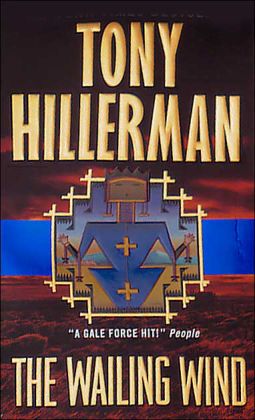
A friend recommended Tony Hillerman. At the local library, I grabbed the title that caught my fancy: The Wailing Wind. I might've cared more about the budding romance between Chee and Bernadette (Bernie) had I started with the first novel in the series. In a few scenes, Chee and Leaphorn occasionally laugh though neither says anything remotely funny. Literary characters should never have more fun than the reader, i.e. me. In contrast, the banter between Hastings and Poirot is quite amusing at times, yet neither of Christie's characters laughed for my benefit. I plan to give Hillerman another try since his setting is the Navajo Reservation circa 1970. The superstitions and religious rites of shaman juxtaposed with modern day amenities was fascinating. Three out of five stars.

Last but not the least bit least, and quite possibly my favorite author of the hour, Lilian Jackson Braun and her first book in The Cat Who series The Cat Who Could Read Backwards. If you enjoy fine writing and Wodehousian humor, check this out. The quirky characters, spot on narrative, clever dialogue, and imaginative scenes, all conveyed in a fantastic style, brought me to the last page before I realized the fun was over. And this is coming from someone who can't abide cats. I've already grabbed book two in the series. Five out of five stars.

One Patterson, Christie, Hillerman, and Braun concurrently to follow, as time allows. Meanwhile, murder mystery mavens, provide your recommendations. I'll read them if I can find them. 

Thursday, June 26, 2014

The Problem of Pain, How Human Suffering Raises Almost Intolerable Intellectual Problems, by C. S. Lewis (published 1940)

As I've mentioned elsewhere, many years ago I was a self-professed atheist. Yet I considered myself open to opposing views. It was in this spirit of open mindedness I accepted a short work a friend and mentor loaned me called Mere Christianity, by C.S. Lewis. Directed to skeptics who seek intellectual reasons for faith, it forced me to question my disbelief. It would be another decade before I squashed my pride, confronted its truth, and converted. (Guess I wasn't so open minded after all.) But that's another story that deals more with the heart than with the head.

I'm convinced that Lewis' conversion from atheism to Christianity contributed to his insight and argumentative powers. Such converts, whether it's the great economist Thomas Sowell (having first been a Marxist before embracing capitalism), tend to speak and write with more authority than those who carry the same political or religious views from cradle to coffin.

I'm not suggesting converts ipso facto make for persuasive writers. Nor does doing an ideological about-face necessarily mean one is more objective or sincere than the next guy or gal. But a lot can be said for having not only examined and lived opposing doctrines but articulating what precisely changed one's mind.

Lewis begins The Problem of Pain with the strongest case for atheism I've ever read. In fact, ironically, I haven’t come across a more compelling argument than the one this former atheist poses. Lewis then goes on to show how such an argument is not only too simple but self contradictory.

The Problem of Pain isn't a self-help or how-to-grieve type work. Nor is it for everyone. Those who lack faith in God or a fundamental knowledge of theology will be as lost as the student who skips basic math and jumps straight into physics. This is for people of faith who want rational answers to perhaps the most challenging question facing believers – why we suffer.

It's no wonder fifty years after his death, Lewis is still widely regarded as the preeminent standard-bearer for apologetics. He's a thoughtful, articulate, persuasive writer, and reading this book made me want to be a better Christian. That alone should recommend it to fellow believers.

How Learning a New Language Improves One’s Life, and other Trivia

Some things are inexplicable. For example, my desire to teach myself a second language at age fifty-two. And what, pray tell, was that secon...