Tuesday, May 14, 2019

Southern Fried Sushi, by Jennifer Rogers Spinola


Southern Fried Sushi is a sermonizing novel. This isn’t a criticism, per se. Sewell’s Black Beauty, hailed as a classic, is sermonizing. Dante’s classic poem The Divine Comedy is sermonizing. For some Christians, such reads can be edifying, serving to reinforce one’s faith. For the Christian like me who prefers subtlety, however, these authors' approaches are, at times, too preachy.

In Spinola’s defense, she can write. Her narrative is particularly good. The story itself is well plotted, coherent, and touching. Characters are well defined. Several scenes moved me emotionally, including, admittedly, a few of these sermonizing scenes. And that’s what storytelling is all about. But because the protagonist struggles with her disbelief while her new-found friends offer answers to dispel her reservations, sometimes lengthy answers, these numerous scenes serve to address the average nonbeliever’s misconceptions about the faith too blatantly for my blood.

While I can sympathize with a writer inclined to testify to her faith or make the case for Christianity, I’m not this novel’s intended audience since I much prefer a story with a moral rather than a sermon posing as a story. Having said that, I recognize, as a writer who has read several books on storytelling, every good story, religious or otherwise, makes a moral argument.

It ultimately boils down to the individual reader’s sensibilities. For example, I’ve read more than a few novels written by Christians who achieved the same objective in ways I found far more tactful, tasteful. Modern Christian writers such as Lisa Sampson and Tosca Lee, what few books I’ve read of theirs (I highly recommend Lee’s novels The Legend of Sheba and Iscariot), never stop their stories to explore the minutia of their faith. Rather their stories offer a more sophisticated approach by way of hints and suggestions. Their moral argument never hits you over the head.

Indeed, one of the reasons I so love the timeless novels of C.S. Lewis, Tolkien, and George MacDonald is because these guys were writers first. Tolkien allegedly wrote in a letter, ‘The Lord of the Rings began implicitly Catholic and ended explicitly so.’ Yet at no point throughout the trilogy is there a single reference to Catholicism or Christianity or The Bible.

I don’t doubt these men’s faith was of the upmost importance to them in their personal lives, but when it came to their novels, they didn’t compromise their art for the sake of a sermon. Instead, their faith shined through as a result of their sincerity and devotion to their writing craft. Their themes were woven into their stories in thoughtful, suggestive, and never obtrusive ways.

Another good example would be Graham Greene’s exquisite novel The Power and the Glory. Greene (another Catholic) never pauses to remind you of the historical horrors of an atheist socialist who hates the church, rounding up priests and executing them in the Mexican state of Tabasco in the 1930s. Instead, the moral argument is made clear by way of the story itself and the poignant scenes throughout which focus on character and plot development.  

But let’s return to Southern Fried Sushi. Shiloh is a young, modern American woman living in Japan and working for the Associated Press until she learns that her self-destructive mother has died. She flies back home to Staunton, Virginia to attend the funeral. There she discovers from her mother’s friends, most of whom are simple Christians with southern hospitality oozing from their ears, that Shiloh’s mother had found religion and devoted her remaining years to helping the deaf and blind.  
   
So far so good, as they say. Over the course of getting her bearings in a new town and attending her mother’s funeral, Shiloh befriends these hayseeds with reservations. Sure. They’re gracious, generous, and apparently sincere. And she’s humbled by their hospitality. At the same time, she’s irritated by their religiosity. She has convinced herself, as most modern, nonreligious people do, that faith is a crutch, most likely a fiction, and that she can succeed well on her own without relying on some pie in the sky belief.

Meanwhile, Shiloh discovers, by way of phone, text messages, and Skype, that back in Japan her fiancé Carlos, a fiery Spaniard, is cheating on her. We as readers already know Shiloh, pressed for time, plagiarized an article for the Associated Press before boarding her flight from Japan to Virginia. In the interim, her boss back in Japan finds out about her unethical blunder and fires her.

Without a job in Japan, she has no valid visa for returning there. Now she’s stuck with all these backwoods rednecks in Staunton, in mounting credit card debt, unemployed, and bucking at these native southerners’ lack of sophistication and poor grammar.

Despite Shiloh’s smug exterior, however, anxiety has set in. As she prepares to sell her late mother’s house, utility bills accumulate. She needs a job, maybe two. But the prospect of employment at a local Barnes & Noble and then, concurrently, as a waitress at a local restaurant, are such blows to her ego, such steep steps down from her career as an AP writer, she initially feels humiliated and ashamed.  

Gradually, after a series of scenes intended to address the modern secularist’s reservations regarding Christianity, Shiloh gradually discovers her misconceptions were only that. Indeed, as she explores The Bible, she realizes the faith makes sense. She needs God in her life.

It’s a touching story, with a balanced amount of well composed detail. Apart from the sermonizing, my only other complaint is with the format. My Kindle version had errors. (I blame the conversion software.) Words would be pressed together in places, with no spaces between them. At other times, lines would drop arbitrarily midway across the page and resume on a line below it. Additionally, several times dialogue between two people would share the same paragraph.

Such interruptions drew me out of the moment every time. However, excluding these software hiccups and the sermons about Christianity via elongated conversations and testimonials, and instead reminded of the emotionally powerful moments and solid narrative, I give this novel four out of five stars. Rated PG 

Friday, April 26, 2019

Story of O, Pauline Réage (aka Anne Desclos)


Published in 1954, shortly thereafter banned, later hailed as a classic, this was one of the most depraved stories I’ve ever read. O, because of her love for Rene, becomes his and his private club members' willing sex slave. Used to satisfy every conceivable fetish and catering to every sexual appetite under the Parisian sun - from anal sex to chains and whips – she is beaten, debased, humiliated, and defiled. Every orifice is violated. Eventually her derriere is branded like chattel and her labia is pierced and tagged. Tragically, the initial reason she submitted to these horrific indulgences was for no other reason than to please her lover Rene. Rene passes her off to his step-brother Sir Stephen because he wants O to serve someone she doesn’t love and who doesn’t love her. Sad, shocking, and written by a female writer, no less, who kept her identity under wraps for forty years after the novel’s publication.

This novel has been described as erotic by some. I didn’t find it the least bit erotic, however. Instead, I found it utterly tragic. Still, the prose style is phenomenal. Extremely well written. And for that reason and that reason alone, I give it four out of five stars. I don’t recommend it, though. Too heart-wrenching and disturbing. Rated NC-17

Friday, April 19, 2019

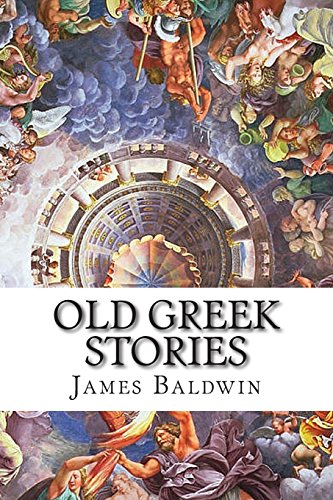
Old Greek Stories, by James Baldwin (1895)


This isn’t the James Baldwin of the early to late 20th century, raised in Harlem, New York, social critic and author of several books and plays, three of which I’ve read: The Fire Next Time, Giovanni’s Room, and Another Country. Instead, this James Baldwin was born in 1841 in Indiana and became a school superintendent at age 24. This James Baldwin died a year and a half after the Harlem James Baldwin was born. This James Baldwin, the school superintendent, wrote and edited so many school text books that, at one point, over half of the school books in use in the U.S. had been either edited or written by him. He wrote primarily for younger students, roughly 50 books, including, of course, this one.

While Old Greek Stories is well written, since it’s geared toward the young adult reader, its telling lacks the more sophisticated style and diction found in the works of Edith Hamilton and Bulfinch. Assuming kids read anymore (though I suspect video games have replaced that pastime), I highly recommend this book for that age group. Five out of five stars. PG

Monday, April 15, 2019

A Glance Behind the Curtain

Writing well requires practice. For me, lots. Practice, that is. I don’t mean the mechanics of typing words on a computer document or putting the nib of a pen to paper. I’m talking about the craft of composing one’s thoughts into sentences and paragraphs that utilize words effectively.

Think about it. Most everything we do involves our five senses and, apart from traffic signs, few words. Good writers struggle to convert or transpose these sensations into an arrangement of words that allow the reader to genuinely experience these moments. When Ignatius turns on the faucet in the dead of Winter and the shower head splits the freezing current into forty-seven tiny needles blasting his chest and causing his body to recoil, we can, hopefully, feel that ice cold water against our own skin, putting us there in that moment.

A good writer is always searching for new ways to describe the ordinary, such as the appearance of the stars in a night sky as pulverized glass. A barefoot child running along the Serengeti as the grass tickles his ankles like a cat’s whiskers. A single engine plane rushing low overhead and roaring like the angry exhaust of a revved motorcycle.    

That’s initially why I began this blog back in November of 2011. My intention was to prod myself to write, to play with words. Similes make me smile. I remember relishing the exercise of describing my journey to retrieve a book from the public library during a Summer thunderstorm in Texas. As you can see, I laid it on a bit thick. “The rain smacked my windshield like pellets. Lightning flared like a heliarc. I finally pulled into the unpaved parking lot, shut off the engine and listened to the terrific kettle drum solo on the roof of my Taurus.”

I figured establishing a modest blog would force me to periodically note the lapse of time, recognize I hadn’t posted anything in weeks, and then sit down and churn out an amusing review that revealed more about me than about the book in question. Instead, the opposite happened. I concurrently immersed myself in a fresh composition, a manuscript for an epic saga, began reading more than I had in ages, and wrote more reviews than I saw fit for posting. I invested my remaining free time in things I regarded as either too personal or irrelevant to a blog I’d subtitled ‘A Blog about Books, Writing, and Anything Else Word-Centric.’

In retrospect, I should’ve opted for the term ‘ego-centric,’ since my pride appears the motivating factor for most of what I post. At the time, I was trying to distance myself from the bloggers who wrote about common everyday occurrences in bland, ordinary ways. Instead, I wanted to write about what I regarded as important and say it in a way hopefully worth reading.

But then a series of things happened in my life, phenomenal things, some of which were related to books I’d read insofar as they changed my life or my outlook. I’d also lost weight, got fit, and switched jobs. All the while, I elected to blog about some of these things while refraining from mentioning others.

Meanwhile I was emailing a friend about things I didn’t consider fit for my blog, amusing encounters I’d had with strangers, acquaintances, and clients on my job. One began “I don’t know what time it was, but the sun was in my eyes. When I said ‘hello’ to her, she smiled wide and giggled, and it was then that I knew she wanted me.” Or this entry from two months ago:

Walked into the office of one of my clients as one of the guys at his computer was telling a fellow employee, ‘I don’t care if you want to wear a dress and heels and take a shit on the floor, you’re still a guy and not a woman.’ To which I, deadpan, rejoindered, ‘Hey! I did apologize for that,’ causing the office to erupt in laughter.    

I’ll never know what impact if any my blog has on anyone. My blog gets lots of hits, but this says nothing about whether these hits represent readers. If someone is searching for a book I’ve reviewed, a link to my blog appears in their search results. They might click on this result, read the first line of my post, ask themselves, “What the hell is this?” conclude, “This isn’t what I wanted,” and close the tab without reading any further. Which is fine. I’ve come to view my blog as more of a diary at this point, chronicling my edited, sometimes ever so slightly embellished, life, regardless whether anyone cares.

This only makes sense, since I write primarily because I enjoy the process. This also explains why I use this medium to reveal my more contemptuous views about society, why I spurn mediocrity, abhor television, mock atheists, and ridicule popular but poorly written novels. I’ve reached a certain age in which I care little about public opinion. I’d much rather tell the truth and risk scorn than ingratiate myself for approval.

Ultimately, I write because I can’t help myself. What I write about isn’t as important to me as the words used to convey it. Hopefully, my eclectic approach, my love for the English language and its malleable properties, entertains and resonates. This blog is my canvas, my practice pad, my vehicle for improvement. That’s my mission, anyway. My impetus. Fuel. Dharma. It’s about time I discuss my extracurricular activities beyond what my current writing projects entail or the books I’ve read.

After recently reviewing some of my old blog posts and catching myself thinking, “Oh! I’d forgotten about that book” or “that event” or “that period in my life” or “that metaphor,” I decided to be a bit more forthcoming about the happenings in my life – my sudden and somewhat endearing fascination with gentleman’s hat apparel, as well as my recent immersion into the Japanese language.


If you visit this blog for the scandal, I can always plead the fifth. If you’ve come for the literary insight, you’ll most likely leave empty-handed. But if you’ve stopped by for an older esquire’s laudable, betimes amusing, efforts to expand, improve, and enrich his life via literature and self-indulgence, please make yourself at home. I’ve left the kettle on. 


Friday, January 18, 2019

To Catch Her Death, The Grim Reality Series, Book 1, by Boone Brux (2013)


I’d like to think of myself as hopeful, optimistic. Will I ever meet that special someone? Probably not. Will I sell ten million copies of my debut novel? Let’s be reasonable. Still, will my investments rise above their double-digits? On second thought, perhaps I’m not as hopeful or optimistic as I think I am. And yet when it comes to art, I’m as eager and as enthusiastic as a teen with fervent hormones on his first date. In fact, I tend to frighten people, particularly non-readers.

Sure. It’s well established that I’m a literary snob. A man of letters, a prose elitist of sorts. However, not everything I read was written a hundred years ago. Not everything else I read is scholarly or highbrow. Indeed, gentle reader, despite my better judgement, I frequently enjoy shutting off my brain and reading a modern high-octane comedy of errors devoid of substance or profundity.

A few months ago, I subscribed to Bookperk, a promotional service from Harper Collins Publishers. The service sends me daily deals via email showcasing ebooks in all genres ranging in price from one to three bucks. To Catch Her Death was one such deal. Based on the cover and the blurb, I anticipated a mildly amusing romp through frivolity. At a mere ninety-nine cents, I figured I couldn’t go far wrong. In that sense, I got what I paid for.

The novel marks my first foray into urban fantasy, and, to its credit, the story provides an interesting concept told tongue-in-cheek. Lisa, an Alaskan thirty-five-year-old mother of three, is a sassy, overweight, unemployed widow whose husband died in a car accident only one year before this story begins. She brandishes sarcasm and wit to cope with all sorts of conflicts, from her mother to her children to her grief to her recent funk. Unfortunately, the humor is extraordinarily predicable, low hanging fruit quality, and hence rarely induces even a grin.  

Happily, the catalyst to the plot happens within the first few pages, when our protagonist witnesses a death and finds herself entangled with the deceased man’s soul. Shortly thereafter, she’s introduced to a secret organization known as GRS (Grim Reaper Services). Yes. Apparently, a secret organization of professionals exist who get paid to reap souls. Lo and behold, Lisa discovers she’s a grim reaper. Not the one and only Grim Reaper but rather one of many.

Obviously for such a premise, the reader must suspend disbelief. Which is fine. Recommended. Commendable even. However, this shouldn’t mean the story abandon its own internal logic. And this is where the eye rolling comes in. Despite my efforts, the analytical part of me kicked in and I couldn’t help wondering, among other things, who funds this organization.

Loved ones of the deceased don’t pay these employees to reap souls. Presumably the government is unaware of the organization’s existence as well, so it obviously doesn’t fund it either. And since income is the primary selling point for our protagonist Lisa who, heretofore unemployed and struggling financially, reluctantly accepts the job, the author should’ve provided some explanation as to how this organization, which works out of a brick and mortar, makes payroll, much less pays its electric and water bills. Hell, tell us a billionaire mystic funds it or that a secret society of millionaire spiritualists contributes proceeds from its share dividends or that the organization poses as a legit bureaucracy the government unwittingly subsidizes. I don’t know. Something.

Unfortunately, the premise, while promising, is a gimmick and nothing more. We’re expected to assume much for the sake of story. This would be fine if the story itself were done well. Unfortunately, the narrative is bland, predicable, and full of clichés. The humor Lisa employs would be better served coming from a teen rather than a 35-year-old mother of three.

Some poor word choices and a stray homonym appear too, such as “… I was not willing to except [sic] more humiliation.” On the plus side, it cost me only a buck and it’s a quick read. But I won’t seek out the rest of this Grim Reality series. Too many other great books are out there I have yet to read. Three out of five stars. Rated PG-13.     

Wednesday, December 19, 2018

The Canterbury Tales, Geoffrey Chaucer (1386), Introduction by Nevill Coghill (1951)

If you were to do a simple search for “great books,” or “most famous books,” or “best books” online, each individual category would yield all manner of material. “One Hundred Best Novels,” “Fifty Books You Should Read Before You Die,” and so on, is subject to the whims of those who compile them. Yet I’ve never spotted a list based exclusively on the celebration of a superb prose style. Guess I’ll have to put together that list myself one of these days.  

Over the course of my own reading career, I’ve discovered that the best books are comparable to good medicine – perhaps difficult for some to get through but beneficial to the mind or the soul. Others are literary cheap thrills, not particularly great but guaranteed to amuse, what Bertie Wooster’s valet Jeeves would term “light but attractive reading.” (I was recently informed that employing the parlance of today would render this sort of book ‘a beach read.’)

Everyone is partial. I’m no exception. As a starting point, as I’ve said elsewhere, even tons of mediocre paperbacks beat some of the best television and film. Of course, my love affair with words in general influences my views on the matter. I’m more likely to read garbage if only for the purposes of learning what not to do when I write. I’m also drawn to the forbidden stuff, books that were once banned or are still regarded as either taboo or perverse or both. This is partly due to what books can achieve – challenging our assumptions, exposing us to issues or ideas none of us would consider otherwise, or, as Sol Stein wrote, and I’m paraphrasing here, dealing with subjects we’d never see entertained in any other media, important things, controversial things, things that require more exploration than a mere sound bite can do justice.

Curiously, I’ll read nearly all manner of material, in any genre. Yet when it comes to film, because I don’t fancy gore, I avoid horror. I don’t mind reading horror, but I wouldn’t watch the stuff if you paid me. You’ll never find me watching a romantic comedy, either. Yet I read romance. I’ve avoided most films in the fantasy and science fiction genre as well, primarily because such subject matter is treated so poorly. Yet I read more than my fair share of same.

I say all that to prepare you for this. Some books rub me the wrong way. I immediately dismiss any list that includes Hemingway, for example. His writing has always bored me. Not the subject matter but rather the unfolding of it. Those who hail William Faulkner’s travesty of a novel The Sound and the Fury might as well sell snake oil as far as I’m concerned. I hated that novel. An absolute mess. The same could be said for Miller’s Tropic of Cancer. That story nauseated me. And while I finished it (you can read my review of it here), I couldn’t get past ten pages of Smith’s A Tree Grows in Brooklyn because the writing style reminded me of grade school. See Spot run. See Jill swing. See Jack drown himself in the sea. I couldn’t stomach Plaith’s The Bell Jar for the same reason. Call me a jerk, a snob, an ass, I don’t care. Though I’ll usually read and finish it, I prefer prose a bit more sophisticated. 

In short, I’m not easily fooled by book lists. I know what I like and why. That said, I still depend on book lists as a guide. One reason is that such lists, for all their faults and bias, have exposed me to certain authors I never would’ve discovered otherwise, subject matter and genres to which I might not have been introduced.

Suppose you’re a fan of film. Further suppose you’re a film critic who watches anything and everything because it’s your job. Now consider how this might make you, over time, more discriminate, more particular about what qualifies as quality filmmaking. Isn’t it safe to say you’d become a bit more analytical, slightly harsher in your criticism, more demanding?

The same holds true for avid readers. Expose yourself to enough high-quality prose, storytelling chops, and skillful wordsmiths and it’ll take more than mere mediocrity to impress you. (There are exceptions. One particular film critic who shall remain nameless evidently loves film so much that once he has pointed out all the film’s flaws and I’m ready to give it an F based on his own critique, I’m bewildered when he concludes by giving the film in question a B- or a C.)

With that in mind, when I saw The Canterbury Tales on a few of these lists, I decided to set aside my high school memories (portions of the book were required reading) and give the book an honest try. I’m glad I did. Not only is The Canterbury Tales the best book of verse I’ve read; it’s one of the best books of both verse and prose.

Chaucer is a master. His knowledge of meter, subject matter, varying diction based on the specific narrator (each character offers a tale), lyricism, not to mention his staggering versatility in approach and mood, is stellar. Setting aside the mechanics, the themes, plots, events, and characters comprising his poems (which are varied and at times hypnotic), the author’s accomplishment in delivery is nothing short of mesmerizing.

Here you’ll find content ranging from the reverential and glorious to the scatological and perverse. The stories are told with both unflinching and engrossing mastery.

Yes. It’s that good. Five out of five stars. Rated R.

Thursday, December 6, 2018

Lies We Tell Ourselves, Sir Mosy Prank

With the Christmas holidays fast approaching, I’ve been particularly busy at work, and the additional hours have cut into my writing time. I reached out to a friend and fellow avid reader who teaches psychology at a local university. He and his wife follow my blog and, with the downtime afforded professors during this season, he agreed to submit a review of his own, a wonderful review, I might add, of a tragic memoir he recently discovered. His reviews tend to be more thorough than mine. I post it unabridged with his permission and for your entertainment.


Loafing on Laundry Day

It’s a familiar phrase with me now: “rummaging through my local used bookstore’s bargain bin …” I’ll refrain from my tendency to invoke the overblown similes I'm prone to employ, in this case comparing bins and books to aquariums and fish or baskets or barrels of apples and instead provide the essentials. High dollar moccasins insulating me from the bookstore’s dusty linoleum, under the cold illume of fluorescent lights, peering into a crate full of paperbacks like a dumpster diver, or, better yet, like a husband peering over a jeweler’s glass display searching for the perfect accessory with crested diamonds for his wife as a surprise, I tucked my tie into my button down, rolled up my long sleeves, and ravaged stacks of obscure orphans abandoned, each with a corner of its cover clipped like a pup’s ears, hoping to relive one of those exquisite moments when a musician in a pawnshop finds a vintage instrument worth a fistful of Franklins selling for a few measly Hamiltons.  

This memoir called to me, Mark. Perhaps the honorific preceding the author’s name, like that of Dr. Wilberforce or Prof. Found or Sirs Walter Scott and Arthur Conan Doyle or Lords Dunsany and Byron, added a certain nobility, a charm appealing albeit somewhat antiquated, which lured me much like when my wife selects an Italian operatic aria from Spotify and prances about the house wearing a yellow ribbon in her hair and nothing else save a welcoming smile. (I apologize if this image torments you, Mark. I realize you’re practically celibate. My condolences.)

The memoir, Lies We Tell Ourselves, by one Sir Mosy Prank (admittedly a dubious, though playful, patronym), is a grave confessional rife with what I must assume is sheer hyperbole, by which I mean that by the third draft the minnow takes on the weight of a whale.     

Because the title hinted at the very things I dealt with as a clinical psychologist, and because Mr. Prank’s patronym (either a non de plume or, as my wife insists, an anagram), and the fact that his memoir was published in 1965, the year I was born, I was impelled to spend the requisite nickel and bring the book home.

“My mother was still a teen when she tried to commit suicide. She drove her Impala off a bridge. She would sport a horseshoe shaped scar on the underside of her wrist the size of a baby’s heel print for the rest of her life as a testament to the attempt. This was years before I was conceived. Years later, at the age of eight, I ate this up. She followed up the story by telling me that my brother and I were the only reasons she hadn’t tried to kill herself again. This puts a strain on a child to make whatever obstacles one’s mother faced in life more bearable. Only I hadn’t a clue about how to achieve that. This was my first lesson in impotence.”

Thus begins an author’s tragic life beset by insecurities and doubt. Prank was the victim of feuding parents who appeared to hate each other. This strife trickled down to him and his younger brother “like that ancient Chinese torture technique of tying down the victim and setting the faucet on drip over his forehead every second until the drops take on the intensity of a hammer.”  

Unlike his brother who bottled up his emotional frustrations, Prank constantly got into fights with the boys in his elementary school, often “beating up a boy for cutting in line at the cafeteria or taking my seat in class.” Before the fall season of his fourth year had ended, he’d been sent to the principal’s office so many times that “the index card the office kept on me resembled a miniature blueprint of Dante’s nine circles of hell,” and the school was forced to call in his parents for a conference.

He describes the frumpy secretary with her perennial scowl, which, he says, reminded him of his mother, the forlorn principal with the plaque sporting his engraved name he proudly situated along the ledge of his desk, and so on, all done in a style harkening to those dime store thrillers in which the protagonist’s psychosis blurs the first person narrative.

His parents were nonplussed as to how this could’ve happened. To their credit, so was Mosy. But this behavior continued until the school sent in a psychologist who managed to draw out enough answers from him to diagnose his mental anguish.

“At the close of the third session, she told me I knew I couldn’t stop my parents from screaming at each other, and I saw no other way to deal with the frustration this generated apart from taking it out on my classmates. The revelation triggered something deep within me, and against my better judgement, in front of this professional stranger, my hard exterior fractured and my palms and cheeks were wet from weeping.”

Alliteration aside, Mosy’s mother, one Mrs. Noisy Park, Park, I initially assumed, being her maiden name (though my wife by way of a shuffling of letters demonstrated Mrs. Noisy Park was an anagram of our author Sir Mosy Prank), claimed her own mother hated her, treated her cruelly, and on one occasion, when Mrs. Park had attempted to explain the benefits of church for their children’s religious instruction to her indifferent husband, Mosy’s father got on the phone to her mother and told her he’d had enough.

Mosy’s grandmother, a hardened woman of the south, growing up picking cotton from dawn till dusk, living on a diet of beans and cornbread throughout her impoverished childhood, told his father he needed to “knock some sense into her.” Mosy’s mother, given her circumstances and thus prone to paranoia, had listened in on the conversation on a hardline in another part of the house.

The revelation, rather than inspiring bitter thoughts and a sense of hopelessness, instead served to reinforce Mrs. Park's belief that the Devil was thwarting her efforts. This view further encouraged her to press her directive even harder. As a result, Mosy and his younger brother were required to memorize various chapters in the Bible weekly. Anything in life not germane to religious faith was forbidden, right down to the toys they played with. Ignorant of the value of childhood escapism, oblivious to the symbolic associations of fairy tale magic, and instead regarding these imaginative exercises as idolatry and moral turpitude, his mother purged their household forthwith. Comic books and super hero action figures were consequently confiscated and thrown away. According to the mother, such powers weren’t of our Lord and were thus demonic in origin.

The boys subsequently were forced to pretend pious lives comparable to that of practicing priests. They were tugged by the ear to every church service and tent revival, often getting home at one in the morning on school days, sitting in classrooms half-asleep, and all round miserable.

This effort on Mrs. Park’s part, which went on for years, had the opposite effect on Mosy and his brother, who grew to resent religion and religious people. Had this instruction been carried out by a more rational parent, Mosy would later speculate, he might’ve taken to it. But throughout his teens, every Sunday, running late, his mother would speed to church, resting her hand on the dashboard, pleading the blood of Jesus over the car, noticing the gas tank registering empty, gritting her teeth and telling the devil, “Satan! I rebuke you in the name of Jesus. Release my car! You will not prevent us from getting to church.”

Imagine! Even as a thirteen-year old, Mosy knew his mother’s behavior was unhealthy and woefully irresponsible. But she was the matriarch of the family and by extension roleplayed the god of the Old Testament, prone to anger, sometimes brutal, and always beyond reproach. Her catchphrase was “Doesn’t matter if I’m right or wrong; I’m the parent!”

One event I found particularly malevolent. Mrs. Park accused Mosy of something he hadn’t done. He denied the charge. His brother, usually silent or absent during such confrontations, insisted Mosy was telling the truth. Mrs. Park then accused Mosy of having manipulated his brother to side with him. Mosy, as surprised by his brother’s alliance as his mother had been, told his mother she was unaware of her cruelty. Whereby Mosy’s mother told him to pack his things and get out of their house.

Horrified, Mosy asked, “You’re kicking me out?”

Mosy’s mother took the opportunity to quote from the film The Odd Couple, in which Walter Matthau’s character tells Jack Lemmon’s character, “Not in other words; those are the perfect ones,” after which she offered a wicked smile. This pronouncement was all the more devastating to Mosy because only weeks before, his mother had introduced him to the film on television. Watching that film had been one of the few treasured memories he had of his mother. Here she’d demonstrated a facetious flair, mocking him, amused by his bewilderment, and indifferent to his subsequent fate.

After a week of sleeping on the floor of a recording studio friends had provided, Mosy’s parents found out about his living arrangements and told him he could return home. Shortly thereafter, when Mosy, miserable about his own circumstances, contemplated suicide, his mother found out and sat him down to tell him his life belonged to God and that therefore he had no right to end it. He reminded her of her own suicide attempt. Whereby she denied it, told him he was mistaken, that the scar along her wrist was the result of a freak auto accident rather than a premeditated event.

Mosy no longer knew which tale to believe. “This is probably where my negative view of women began,” he writes. “They couldn’t be trusted. Their stories were calibrated to suit their audience.”

This distrust informed his subsequent failed relationships and strained romances. Mosy refers to that less popular song by the 80s band The Police and the lyric, “Why does every girl I go out with become my mother in the end?”  

One fetish he shares with the reader, though he doesn’t attribute it to his mother, has to do, I suspect, with his mother’s habit of caking her face with makeup “to the point at which she resembled a carnival clown, sans the foam nose. Lipstick as red as arterial blood, rouge insinuating the rigors of sex, and hair coiffed to qualify as museum art put me off my feed even as a teen with raging hormones.” His fetish made him particularly vulnerable to the wiles of women “who either wore no makeup or wore so little as to appear honest.” He attributes this preference, wrongly I suspect, to “finding an unassuming woman whose passions and pursuits left no room for pretense.”

Mosy insists that while he assumes responsibility for his life, he can’t help but wonder whether the example his mother set, that early role model representing all things feminine, was the reason he and his brother remained bachelors up to the publishing of this memoir and (I presume) beyond.

According to Mosy, his brother was much like his father – aloof and cowardly. Whereas Mosy was, to his chagrin, much like his mom – overly sensitive and scatterbrained. Discovering this early on propelled him to change:

“Because my mother routinely, daily, misplaced her keys, her driver’s license, her checkbook and her credit cards, and with the introduction of the cell phone, that too, she’d send her sons on treasure hunts that to this day I’m convinced is the reason I always place my own keys and cards and phone in the same spot after coming home from work every day so as to never mislay them and have to interrupt my life to retrace my steps.”

While his father made good money as a licensed pipefitter for a major auto plant, Mosy’s mother spent at least half those earnings on jewelry, dresses, and her ever increasing shoe collection, meanwhile writing hot checks to cover the hot checks she wrote the day before and shopping for her two growing boys at hand-me-downs shops and Goodwill stores. As a result, Mosy and his brother always wore clothes too small for their growing size. Invoking the principle of big lakes producing big fish, Mosy insists this led to his development of a “penis the size of a wine cork.”

I can only sympathize with such men whose manhood fails to impress, myself endowed with what my wife China ironically refers to as both her “Scylla and Charybdis.” I’ve never dared to ask her, but I suspect this allusion stems from the irreverent twig and berries euphemism, since it’s China’s long-standing practice to supplement supernatural occurrences (ancient tales of monsters) with natural explanations (undertows, riptides, deadly whirlpools), something she insists Ulysses and his crew most likely experienced, should the classic tome bear any authentic fruit.

“I don’t blame my mother any more than I blame a bird for eating worms. Sure. We’re responsible for our behavior. But when my mother pressed her palm to my forehead and yelled, ‘Satan! Release my son!’ I’ve no doubt she meant well. In her world, spiritual warfare, the battle between angels and demons contending for our souls, were the powers and principalities influencing our fate. Prayer, not planning, religion, not reason, would lead to a good life. Only if this defined the good life, I was shaping into a villain. That was one path she hadn’t anticipated. Yet in keeping with children following by example it shouldn’t have surprised her.”

Understandably, considering Mosy’s experiences, I, too, would have grown suspicious of religion and those who represented it.

“While I’d like to say once I left the nest, I never looked back, instead I made the mistake, again and again, of returning to that environment. Whether I considered myself capable of curing my mother’s mental illness or merely found solace in the familiar, albeit dysfunctional, familial unit, I don’t know to this day.”

Grim reflections, to be sure.

“I suppose I still wanted to believe these anecdotes were merely a series of isolated events in an otherwise normal family. Perhaps, I often told myself, we forget the euphoria of unwrapping the gifts on Christmas morning and remember only the drudgery of cleaning up afterwards. But these weren’t isolated events or sparse tragedies peppering an otherwise average childhood. They were variations on a recurring theme, a life of unpredictable, frightening scenes shaping boys into jaded, self-conscious neurotics.” 

I’d be remiss if I didn’t take this opportunity to employ my many years of experience as a clinical psychologist. Given such an upbringing, Mosy probably didn’t realize the best method for dealing with such a history is to first forgive and then to never look back.

As you know, we psychologists unanimously advise patients who suffer these relationships to weigh their options. The options are always the same: first recognize that you can’t change anyone, no matter how hard you try, particularly if those people neither want nor see the value in changing. Hence, you must either accept such people as they are or you must avoid them.

Second, associating with such people benefits no one. In fact, such associations tend to arrest the progress of those who wish to become something more. And no matter how you word it, explaining this to those who’ve wronged you does nothing to resolve the issue.  

I can only sympathize with Mosy, having led a perfect childhood with adoring parents. I’m sure my folks disagreed on occasion, but the pervading harmony would’ve made many of the Austrian composers of the classical era fawn. My healthy relationships with my doting parents fostered an outlook conducive to social interaction with peers and ultimately marriage to a woman whose inner and outer beauty inspires envy among her book club friends and lusts among mine.  

Mosy goes on to chronicle the divorce between his parents, his father moving to a distant state, his mother remarrying a man who’d cheated on his previous two wives and whose unchecked philandering led to the dissolution of his marriage to Mosy’s mother as well, the step-siblings who, while amusing in their youth, would disregard Mosy’s earlier efforts to act as mediator on their behalf to lessen the brutality of his mother’s parenting during their formative years and later treat Mosy as a pariah, their “low brow trailer trash” mentality, Mosy’s words, “both rudderless and promiscuous,” invoking the voodoo of failed marriages and financial foundering.   

Again, unlike Mosy and his fate, my own father was a role model who taught me the value of honesty, who gave me a leash long enough with which to entangle myself but encouraged me throughout my growing pains until I could see the value of independence. My mother, who shaped the course of my more tender side, instilled the notions associated with class, etiquette, propriety, and discernment. By way of her example as a lady, I would adopt the tenets by which she lived – wisdom, compassion, charity.

As we’ve discussed on numerous occasions over scotch and cigars, Mark, my own parents practiced these virtues and insisted I do the same until I eventually recognized and appreciated these same virtues for the balm they would prove in more difficult times. It pains me to know philistines such as those comprising Mosy’s family, with their reckless disregard for responsibility as parents beyond providing diapers and shelter, molds their progeny into the kinds of people the parents themselves no longer like and, in some cases, resent. Telling parenting to be sure. For all I know, Mosy resides in a psych ward and diligently takes his prescribed meds.

Now if you’ll excuse me, China ascends the staircase as I write this, providing me with the allusion of what I can best describe as a swaying cello, her hips taking on the swing of a hypnotist’s pocket watch, scattering laurels along the carpeted tiers in her wake. Oh! Now she insists I join her for a bit of bedroom roleplay in which she dons the garb of Penelope and I Ulysses after a decade long deployment overseas. I’ve just assured her I haven’t slain her suitors this time but have only redirected them to the banquet out back. I’ll give her a few minutes to refresh herself. If it’s anything like our last exertions, I’ll find my love reclining across the comforter as if posing for a sketch artist, draped in a chlamys she bought at a costume boutique, smelling of bath oils, and batting her lashes. Scylla and Charybdis indeed.   

How Learning a New Language Improves One’s Life, and other Trivia

Some things are inexplicable. For example, my desire to teach myself a second language at age fifty-two. And what, pray tell, was that secon...